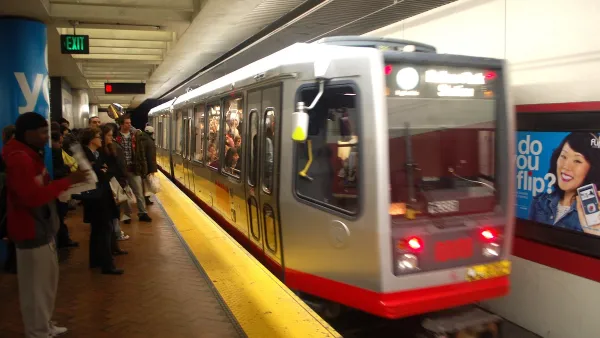
"Blueprint America" looks at declining public transit subsidies and resulting transit service cuts. The video and report follows two East Bay commuters on suburban bus, BART; the transit agency meeting where bus service is reduced; MUNI LRT footage.


"As the economy has slumped, Americans have increasingly turned to mass transit, putting new pressure on transit agencies. In a new report for the "Blueprint America" series, correspondent Rick Karr examines the budgetary issues facing public transit.
In part one, Karr looks into the growing deficit in what it takes to run day to day operations of buses, subways, and trains - deficits that have prompted more than 60 agencies nationwide to propose fare increases, service cuts, or both, even as more Americans are using transit than at any time in the past 50 years.
In part two, Karr looks into a looming crisis on the capital side of transit agencies' budgets, the result of complex financial deals that the agencies made in the 90s to stretch their meager budgets, but which melted down with the rest of the financial sector - and could leave cash-strapped transit systems owing bankers hundreds of millions of dollars."
Thanks to Leonard Conly
Read the full story: Transit in Trouble: Part I
California Revives $750M Loan to Save Bay Area Transit
The state approved a $750 million loan as a stopgap measure to fund regional transit agencies until a 2026 ballot measure that could bring more permanent funding.

California Rejects Loan to Save Bay Area Transit
The state’s Department of Finance wants to extend negotiations about the loan, making it unlikely transit agencies will receive any assistance before the end of the year.
San Francisco Transit Faces ‘Devastating’ Cuts
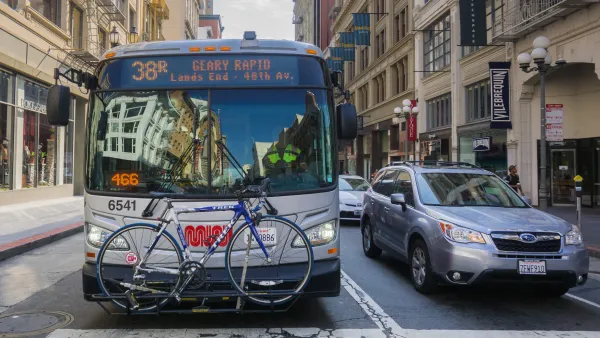
SF Muni is the latest transit agency to sound the alarm on its funding woes, announcing a slate of massive proposed service cuts it will have to make without new revenue sources.

Planetizen Federal Action Tracker
A weekly monitor of how Trump’s orders and actions are impacting planners and planning in America.

Eastern Nebraska is running out of electricity
Data centers and electrification are straining eastern Nebraska’s grid, throttling economic development.

Study reveals best places in the U.S. for cycling, walking
New research from Streetlight Data examines bicycle and pedestrian miles per capita in the 100 largest U.S. cities by population.

DSA members accuse Mamdani of 'abandoning values' over housing redevelopment
New York City's mayor plans to replace about 2,000 units of public housing with private, mixed-income housing.

All sides of BRT debate unhappy with CDOT’s most recent move
The Colorado Department of Transportation is no longer considering center-running bus lanes for Colorado Boulevard.

Massachusetts bogs generate both power, and cranberries
Putting solar panels above farmland is one way Massachusetts is advancing toward its goal of net-zero carbon emissions by 2050.

FREE Course: Walkable City 1: Why Walkability?
After describing his path towards focusing on walkability as the essence of good planning, Jeff Speck marches through his five principal reasons for making more walkable places.
Reinventing Malls: Planning Alchemy—Turning Gray Fields Into Gold
The course focuses on the opportunities and imperatives that shape reinvention of mall sites.

City of Rosemead
Rutgers University, Edward J. Bloustein School of Planning and Public Policy
One Hundred Miles
University of Michigan School for Environment and Sustainability (SEAS)
Hunter College, City University of New York (CUNY)
The Architects Foundation
City of Cambridge
The Pocatello Development Authority
The Urban Renewal Agency of the City of Pocatello