Neuroscience
Using Neuroscience to Build Neighborhoods
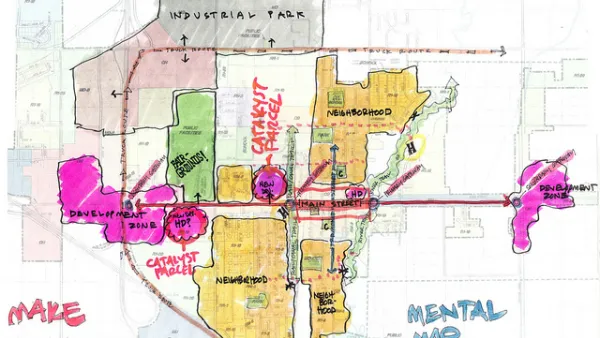
The brain has a complex, ancient relationship with place. Mental maps are the manifestation of our brains' perception of place and wayfinding. These maps can have profound impacts on how residents appreciate, and improve, their neighborhoods.
Neuroscience and Landscape Architecture
Two new studies use EEG and fMRI to pinpoint which elements of urban parks and gardens induce brain activity associated with meditative states.

Architecture on the Brain
Emily Badger examines the intersection of neuroscience and architecture, an emerging area of study that promises to produce environments that support and enhance our brain function.
Are You a Narrative or Spatial Navigator?
Jarett Walker finds out how many people can recognize north in the subway. The survey is used to explain the distinction between narrative and spatial navigation, which appear to be the two predominant forms of human navigation.
The Neuroscience of Architecture
Recent studies in neuroscience show that the design of the built environment affects the way you feel and your behavior. New brain scan technology is revealing emotional reactions to color choice, rounded corners, and ceiling height.

FREE Course: Walkable City 1: Why Walkability?
After describing his path towards focusing on walkability as the essence of good planning, Jeff Speck marches through his five principal reasons for making more walkable places.
Reinventing Malls: Planning Alchemy—Turning Gray Fields Into Gold
The course focuses on the opportunities and imperatives that shape reinvention of mall sites.

City of Charlotte
City of Rosemead
Rutgers University, Edward J. Bloustein School of Planning and Public Policy
University of Michigan School for Environment and Sustainability (SEAS)
Hunter College, City University of New York (CUNY)
The Architects Foundation
City of Cambridge
The Pocatello Development Authority
The Urban Renewal Agency of the City of Pocatello









