C.J. Gabbe guest blogs about a recent article in the Journal of Planning Education and Research.




Guest Blogger: C.J.Gabbe of Santa Clara University.
The quantity, quality, and location of new housing affects affordability, climate change, and social equity. Zoning changes that enable more housing construction ("upzoning") are often necessary and yet we have little empirical evidence about where and why rezonings occur. In a recent article in the Journal of Planning Education and Research, I examine the prevalence and characteristics of upzoning in Los Angeles.
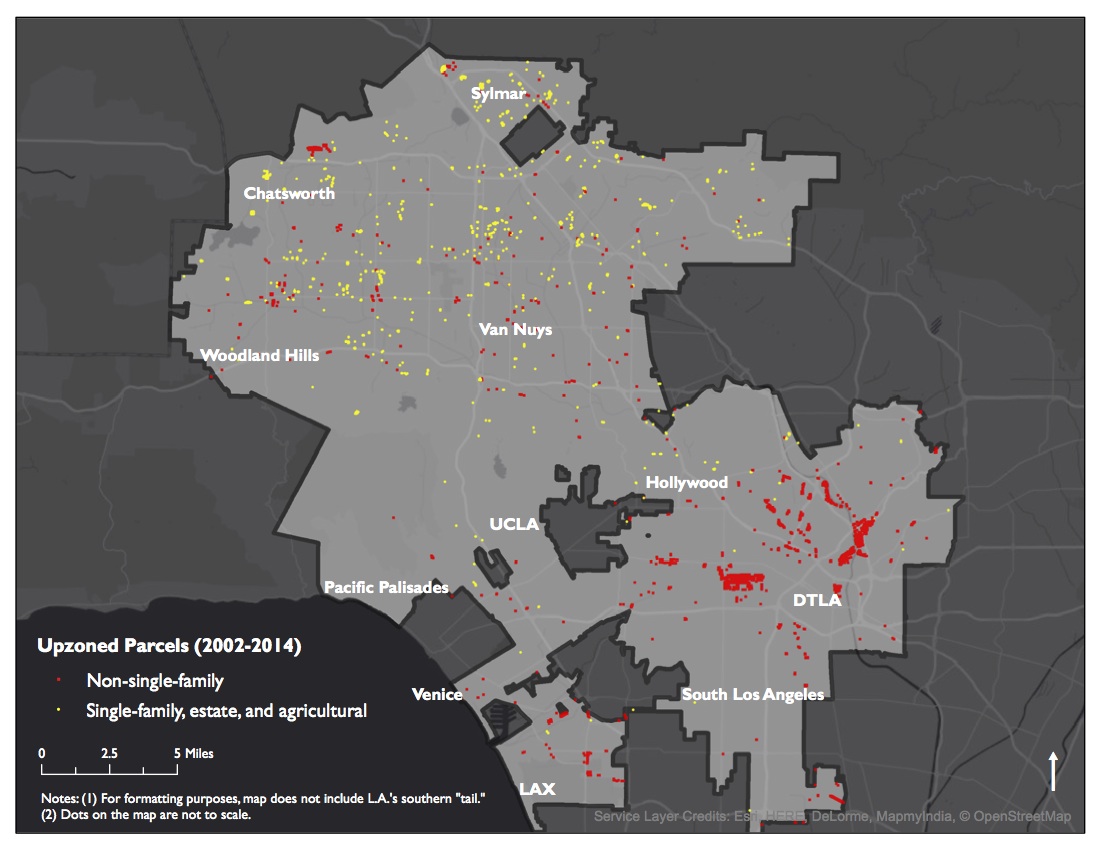
To set up my analysis, I began by assigning every Los Angeles parcel with zoning attributes from 2002 and 2014. I flagged areas where zoning changed, and I focused on parcels where more residential development was allowed. I then developed regression models to estimate the odds that a given parcel was upzoned after 2002 based on its neighborhood amenities, regional accessibility, transit proximity, initial regulatory characteristics, environmental features, and local socioeconomic and demographic characteristics.
My research shows that upzoning was uncommon in Los Angeles. Only 1.1% of the city’s parcel land area was upzoned between 2002 and 2014. Some of this upzoning was city-initiated following adopted plans, but property owners initiated many of the upzonings. When upzoning did occur, it commonly followed a path of development opportunity combined with least political resistance.
Upzoning was most likely for parcels:
- Zoned for low-intensity uses, like parking and manufacturing.
- In neighborhoods with rising rents.
- In sections of Los Angeles with newer community plans.
Upzoning was least likely:
- In neighborhoods with larger shares of homeowners.
- Nearer to the beach.
- Close to elementary schools with higher standardized test scores.
Many American cities–like Los Angeles–will need to update their plans and approve zoning changes to achieve broad policy goals of limiting sprawl; increasing walking, biking, and transit ridership; improving access to good schools and jobs; and expanding housing supply. Based on this and related research–and my experience in planning practice–I propose four key principles for planning and regulating urban development:
- Zoning changes should follow deliberate, inclusive, and transparent planning, rather than ad hoc decision making. If a long-range planning system isn't functioning smoothly, there will be conflicts downstream about zoning and development approvals. This is Los Angeles' situation today; the city is now moving toward updating its 35 community plans.
- Cities change, and planning processes must be framed around "how to change" rather than "whether to change." Some existing residents express concerns about protecting their access to amenities and "neighborhood character." Again, my research shows that upzoning was particularly unlikely in neighborhoods with high shares of homeowners. Planners can partially mitigate these concerns by linking new development with public improvements, and through clearly written and predictably applied regulations. But, planning for growth requires political leadership, and ultimately will be a compromise for some local stakeholders.
- Citywide policy changes may be more politically feasible than piecemeal parcel- and neighborhood-scale changes. For example, a city can systematically reduce minimum parking standards near transit stations–rather than selectively in certain station areas–or allow accessory dwelling units without additional parking requirements in all single-family zones. This kind of holistic approach can reduce case-by-case decisions, even if policies are designed to account for some context-related factors.
- Sometimes state intervention is necessary to break planning and zoning logjams. State governments should intervene when restrictive municipal regulations hinder regional housing and environmental goals, particularly near major transit investments. For instance, California's density bonus incentives allow streamlined approvals, higher densities, and other regulatory relief in exchange for affordable housing provision.
In short, planning for the future may not be easy, but it shouldn't be impossible. Through proactive planning followed by zoning updates, growth can be equitable, environmentally sensitive, and meet the needs of existing and future residents.
Open Access Until May 31, 2017


LA delays state housing mandate with 'low-rise ordinance'
The new ordinance allows the city to delay implementing SB 79, a state law requiring more density near transit.
L.A.'s Crackdown on McMansions Hasn't Stopped Them from Going Up
Legislation to stop construction of McMansions is being undermined by a zoning loophole.

Mapping L.A.'s Zoning Changes Finds Little Room for Upzoning
A new study makes a visual case against the narrative that spot zoning and a broken development approval process are running roughshod over the entire city.

Planetizen Federal Action Tracker
A weekly monitor of how Trump’s orders and actions are impacting planners and planning in America.

Amtrak, CN end decades-long dispute with eight-year agreement
The new operating agreement establishes an updated framework for the companies to work together, including processes to resolve disputes.

Judges permit Denver to divert 77,000 acre feet from the Colorado River for reservoir expansion
Overuse and climate change have caused the Colorado River’s water levels to plummet.

Alabama scores up to $2.5 billion federal loan for largest infrastructure project in state’s history
The Mobile River Bridge and Bayway Project aims to ease congestion at Alabama’s worst bottleneck.

Trump is considering data centers on 6 states' public land — some state officials say they had no idea
If the administration approves the proposed projects, data center and data center-related developments will cover 17,600 acres of public land.

Despite court ruling, Trump is keeping nearly all wind projects in the US on hold
At least 110 wind energy projects have not heard from the government since a federal judge ruled that the Trump administration's freeze on wind turbine clearances was likely illegal.

FREE Course: Walkable City 1: Why Walkability?
After describing his path towards focusing on walkability as the essence of good planning, Jeff Speck marches through his five principal reasons for making more walkable places.
Reinventing Malls: Planning Alchemy—Turning Gray Fields Into Gold
The course focuses on the opportunities and imperatives that shape reinvention of mall sites.

KFH Group Inc.
Greater Baltimore Committee
Eagle County Government
The Architects Foundation
University of Cincinnati Online
The Pocatello Development Authority
The Urban Renewal Agency of the City of Pocatello

