To help its bottom line, struggling UK retailer Tesco is planning to open up its parking lots and the space above its stores for new housing development.


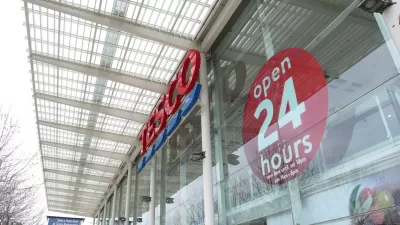
As London struggles with a housing shortage, supermarket chain Tesco is offering up a solution to provide more housing, while also shoring up its own finances. Ashley Armstrong of The Telegraph reports that the retailer is planning to sell off air rights above its stores and in its parking lots for new housing development, a plan that analysts say could net the company £1.5 billion.
Val Bagnall of Apex Housing Group said supermarkets were talking about air rights as a way to “sweat their assets”. “It not only shifts the burden of roof maintenance costs on to a developer but could also be a significant income driver.
“There are also plenty of superstore car parks which sit empty when the shop is closed and could be better used. For Tesco, it could generate huge financial value,” Mr Bagnall added.
Armstrong reports that new developments in London at Tesco and other stores could create 180,000 housing units.
Read the full story: Tesco Towers: supermarket enters the fray with a radical new solution to the housing crisis
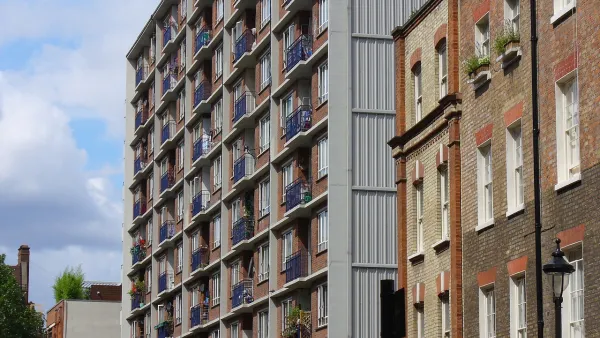
UK Election May Turn on Housing
While Brexit is the main focus of upcoming British elections, the skyrocketing cost of housing is also gaining attention.
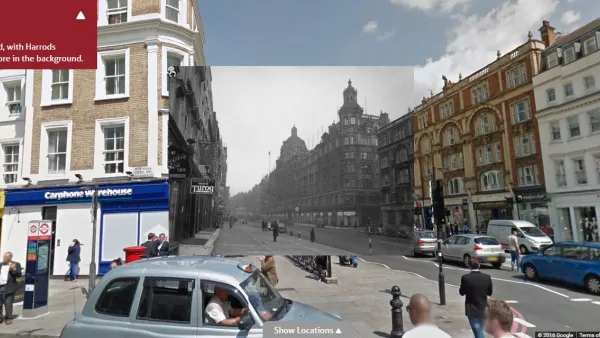
Friday Eye Candy: Historic London Visualized
Historic London collects panoramic views of modern London streets with historic photos transposed over them. Most of the views date from the first two decades of the 20th century.

Designing the Shadow-less Skyscraper
Architects at NBBJ in London have designed a building—two buildings rather—that work together to cancel out the shadows they cast.

Planetizen Federal Action Tracker
A weekly monitor of how Trump’s orders and actions are impacting planners and planning in America.

Washington state to charge fee to drivers with fuel-efficient cars
Revenue from the fee will go towards supporting the state’s highways.

Trump to blast ‘hydrocarbon highway’ through ‘world’s longest art gallery’
Environmental and historic preservation groups are suing to stop the project.

Minnesota Gold Line extension now has launch date
Plans to extend the Gold Line have existed since 2025.

Data centers need power – lower income, rural residents pay the price
In 2025, data centers paid only 38% of the energy infrastructure costs linked to their growth, with households, especially rural and low-income residents, bearing the remaining burden.

MBTA Green Line project moved to next phrase of CIG program
The modernization effort will cost $4.08 billion.

FREE Course: Walkable City 1: Why Walkability?
After describing his path towards focusing on walkability as the essence of good planning, Jeff Speck marches through his five principal reasons for making more walkable places.
Reinventing Malls: Planning Alchemy—Turning Gray Fields Into Gold
The course focuses on the opportunities and imperatives that shape reinvention of mall sites.

City of Charlotte
City of Rosemead
Rutgers University, Edward J. Bloustein School of Planning and Public Policy
University of Michigan School for Environment and Sustainability (SEAS)
Hunter College, City University of New York (CUNY)
The Architects Foundation
University District Partnership