Exploding global population numbers and worries about escalating energy prices, climate change, and energy independence have placed a priority on net-zero building. This article explores the viability of net-zero communities and cities.


"While some net-zero homes have been a reality for several years, it’s the commercial projects and communities that are getting the most attention as they will have a profound impact over time. The nation’s largest net-zero commercial building is located in Greater Los Angeles and was dedicated in June 2016. This 144,000 square-foot building will serve as both a living laboratory and demonstration center to showcase energy-efficient design techniques and clean energy technologies."
"Now that we know how to construct net-zero buildings, the next move is towards entire towns and cities. Perhaps a lofty goal but some communities are well on their way towards its achievement. Sacramento, CA currently has the most net-zero buildings of any city in the country. Despite this, the California state capital would have a long way to travel to reach total net-zero status as a city. However, the small community of Cambridge, MA is working on total net-zero zoning as a city. This is a long-term project that calls for a 70 percent reduction in building emissions by 2040."
"As technology and design techniques continue to improve, the net-zero movement is expected to pick up pace. While cost is a current challenge with these projects, further advances in coming years should make many of these solutions more attainable for both small and large-scale net-zero projects.
Read the full story: Is Net-Zero Building Realistic on a Large Scale?


‘Fish-Friendly’ Washington Development Blends Affordability and Sustainability
A community land trust took on a difficult site in suburban Seattle — and ended up with a sustainable, diverse, mixed-ownership-form development that challenges multiple norms.

USDOT Unveils Strategies to Achieve Near-Zero Transportation Emissions
Three key strategies — reducing travel distances, increasing energy-efficient travel modes, and transitioning to zero-emission vehicles and fuels — are recommended to meet national climate goals under the Paris Agreement.
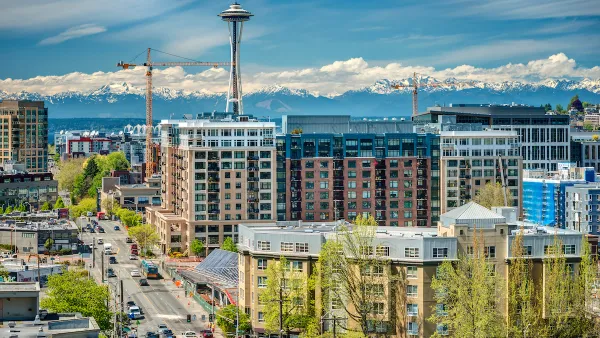
Seattle Passes Building Emissions Law
The law calls for buildings larger than 20,000 square feet to eliminate fossil fuels by 2050.

Planetizen Federal Action Tracker
A weekly monitor of how Trump’s orders and actions are impacting planners and planning in America.

Amtrak, CN end decades-long dispute with eight-year agreement
The new operating agreement establishes an updated framework for the companies to work together, including processes to resolve disputes.

Judges permit Denver to divert 77,000 acre feet from the Colorado River for reservoir expansion
Overuse and climate change have caused the Colorado River’s water levels to plummet.

How ‘post-disaster gentrification’ alters neighborhoods after natural calamities
After hurricanes, fires or other calamities, the original residents of a community are often replaced by younger, wealthier residents.

Maryland local governments examine if they should have more power to raise property taxes
Maryland’s housing market is out of reach for the majority of moderate-income residents.

Northwest rail fans eager for Sept. 30 debut of Amtrak’s Airo fleet
Get ready for that new train smell and more seats. But they won’t go faster or run more frequently on the Cascades route in Washington and Oregon.

FREE Course: Walkable City 1: Why Walkability?
After describing his path towards focusing on walkability as the essence of good planning, Jeff Speck marches through his five principal reasons for making more walkable places.
Reinventing Malls: Planning Alchemy—Turning Gray Fields Into Gold
The course focuses on the opportunities and imperatives that shape reinvention of mall sites.

Harvard University Graduate School of Design
KFH Group Inc.
Greater Baltimore Committee
The Architects Foundation
University of Cincinnati Online
The Pocatello Development Authority
The Urban Renewal Agency of the City of Pocatello