Inclusionary zoning and weakened urban growth boundaries are not effective tools for reducing the price of housing. Joe Cortright of City Observatory suggests ending parking requirements instead.


Joe Cortright analyzes the potential consequences of a political trade off regarding a process to reform some of the regulations that impact land use and development in Oregon.
As has already been reported, the Oregon State Legislature is considering a package of bills that could overturn the state's ban on inclusionary zoning. The legislation is proposed as a measure to counter the state's rising affordability problem. In the negotations leading up the inclusionary zoning legislation, the development and building industries is asking for something in return:
As a quid pro quo for agreeing to drop the ban—at least for rental housing—the development industry is suggesting it would like to see the state’s land use laws, including its signature urban growth boundary, weakened.
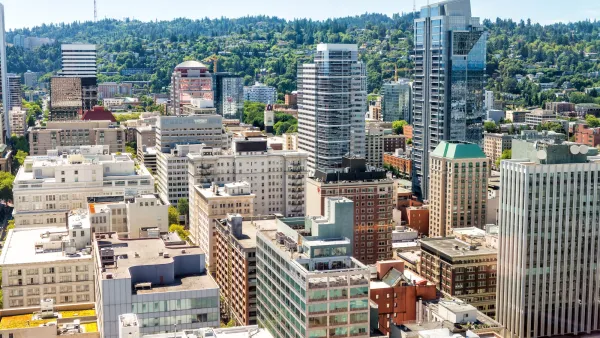
Cortright's focuses on the consequences of "bursting" Portland's urban growth boundary. In fact, Cortright says that possibility, combined with new inclusionary zoning, would likely make Portland's affordability worse.
To back up his larger claim, Cortright lays out a seven-point argument, each detailed in the article. Here's an abridged version of the list:
- Affordability is about growing up, not out.
- The market demand/affordability problem is in the urban core.
- Adding more supply in the core is the key to addressing affordability.
- Inclusionary zoning increases market prices.
- Inclusionary zoning creates only token numbers of affordable units.
- Inclusionary zoning requirements would encourage further sprawl.
- If we want to make housing more affordable, let’s get rid of parking requirements.
Read the full story: Bursting Portland’s urban growth boundary won’t make housing more affordable


Inclusionary Zoning and Unintended Consequences
The city of Portland is considering a new inclusionary zoning policy, but some believe that inclusionary zoning has the opposite of its intended effect.

If Housing Affordability Is Top Concern, Let Metro Regions Sprawl
Research from BuildZoom, a San Francisco-based contractors' website, shows that housing affordability increases with a region's ability to build outwards, as opposed to upwards. Densification largely has not accompanied efforts to curb sprawl.
Portland Affordable Condo Project Offers a Path to Homeownership, but is it a Long-term Solution?
The project's affordability currently rests on temporary subsidies and market goodwill. For tenants who can’t buy—and future buyers looking for affordability—the risks are significant.

Planetizen Federal Action Tracker
A weekly monitor of how Trump’s orders and actions are impacting planners and planning in America.

Amtrak, CN end decades-long dispute with eight-year agreement
The new operating agreement establishes an updated framework for the companies to work together, including processes to resolve disputes.

Judges permit Denver to divert 77,000 acre feet from the Colorado River for reservoir expansion
Overuse and climate change have caused the Colorado River’s water levels to plummet.

Atlanta City Council unanimously backs $3.5 billion Beltline light rail project
The resolution was drafted after Atlanta Mayor Andre Dickens pulled support for the Atlanta Streetcar extension last year.

SEPTA to bring nearby frequent transit to over 1 million new riders as part of decade-long plan
The agency's Accelerate plan will also bring frequent transit to twice the amount of jobs that are currently located near it.

NYC plants over 18,000 trees, the most new foliage in a decade
Many of the trees were planted in communities vulnerable to extreme heat.

FREE Course: Walkable City 1: Why Walkability?
After describing his path towards focusing on walkability as the essence of good planning, Jeff Speck marches through his five principal reasons for making more walkable places.
Reinventing Malls: Planning Alchemy—Turning Gray Fields Into Gold
The course focuses on the opportunities and imperatives that shape reinvention of mall sites.

City of Thousand Oaks
City of Wisconsin Rapids
Harvard University Graduate School of Design
The Architects Foundation
University of Cincinnati Online
The Pocatello Development Authority
The Urban Renewal Agency of the City of Pocatello