How do we personally advance nature in cities? This blog post looks at "urban nature" and the research revealing how me might lessen the damage we do to the nature that surrounds us every day.


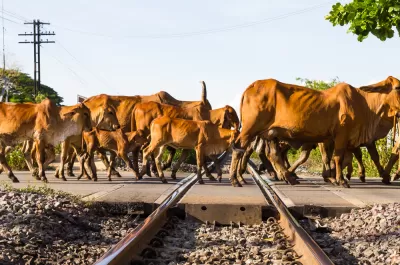
Each year millions of wild animals are killed by cars.[i]
Millions.
About a billion birds die every year from building strikes.[ii]
Yes, a billion.
Alarming.
These are animals we directly destroy. Set aside sea-level rise, habitat loss and degradation, and spreading development. This is destruction via the very places we work or live and how we often get about.
How can we foster change to lessen this devastation inflicted upon nature?
In my previous post I reframed an understanding of cities to recognize that our urban environments offer opportunities to conserve nature. I began to develop a perspective of cities less as a human construct and rather as a spatial configuration exhibiting augmented ecological processes; a type of place dictates a type of nature: no nature in some instances; pest nature in others; and nature that tends to exhibit "urban nature" in another. Our cities could lean toward the latter, and I'm proposing a three-part series of how to get there.
One, awareness—that was my previous post. If we're cognizant that cities can support natural ecological processes—and we want this—we can look at how to protect and nurture them;
Two, behaviour change. What can we personally do, and not do, to advance nature in cities?
Three, how to get nature (back) into cities. How do we plan and manage cities to advance a supportive urban ecology and to protect biodiversity?
In this blog I’m addressing point two.
A recent European report on attitudes towards biodiversity revealed that a majority of respondents are familiar with the terms "biodiversity" and "biodiversity loss." This is a success. The tendency, however, is to draw little connection between urbanization and biodiversity loss. Biodiversity is largely associated with major natural areas and water bodies. We recognize it as a serious global problem but we fail to tie it to the place where we live, how our everyday lives destroy biodiversity. This is a failure, and this is the gap we must fill.
But before we look at changing behaviours, perhaps it's worthwhile to have a definition of what it is we're trying to protect: urban nature. This is the type of nature that the majority of us experience in our day-to-day lives.
Oxford dictionaries define nature itself as, "The phenomena of the physical world collectively, including plants, animals, the landscape, and other features and products of the earth, as opposed to humans or human creations." Biodiversity can be used as a way to measure this physical world, and as a way to describe it, to analyze the complex variety and interactions of nature.
An organization whose goal is to advance local biodiversity conservation, ICLEI Canada provides an insightful definition of urban biodiversity. Their document, BiodiverCities: A Primer on Nature in Cities, states that urban biodiversity is the "variety and richness of living organisms and habitats found in and on the edge of human settlements, including remnants of natural landscapes, traditional agricultural lands and urban-industrial areas." I’d add that it exists on the stuff we build too, in concrete cracks and roof-tops; it runs down alleyways and nests under billboard signs and atop lamp-posts. The large natural landscapes are the core biodiversity areas. How we connect these key habitat areas are the corridors that allow urban nature to move through the city.
With this articulation of urban nature, and recognizing that cities have a role in conserving and advancing biodiversity, we can ask how we might provoke behaviour changes in support of it.
A place to start is to recognize conservation is not solely in the realm of professionals. The public has a key role in executing conservation goals. Research on increasing the general public’s involvement in conservation activities revealed three important considerations to foster "pro-conservation attitudes and behaviour" in the general public.
The first: Conservation issues must be integrated into a wider network of social relationships. The more we know, and our friends, know about nature, the more we're prone to tell others about conservation activities and act to support them. Social inclusiveness with an environmental ethic tends to support environmentally positive behaviours.
Second: Observing everyday nature often makes people consider its functional and evolutionary characteristics. The more we are in nature, the more we recognise the role it has in our lives. We might not be able to describe it scientifically, but something about it feel right, makes us feel right, which causes actions to seek feeling right and to protect what makes us feel right.
Third: Scientific knowledge seems necessary to help people to develop their own position on nature. A deep understanding of a phenomenon—be it art history or grammar or calculus—tends to induce a richer appreciation of its role in our lives. This is what scientific learning encourages.
The research reveals that repeated observations of nature can increase our knowledge and beliefs about the importance of nature. This seems to accord with knowledge acquisition in general. The more we understand something the more we are drawn to discuss it, to share it, to continue exploring it. When we begin to change our behaviours to support nature, we begin to require the places where we live be designed for us and nature. We take another step in helping us to wild cities.
Connect Steven on Twitter @stevenpsnell or Facebook stevenpsnell. Download his novel, Clear Running Water, at Smashwords.
[i] US number. Not confined to cities, but indicative. The Human Society of the United States. Scholarly material not cited. http://www.humanesociety.org/issues/wildlife_roads/?credit=web_id893837…
[ii] US number. Secondary source material via Ontario Nature http://www.ontarionature.org/protect/campaigns/birds_and_buildings.php

Washington state to charge fee to drivers with fuel-efficient cars
Revenue from the fee will go towards supporting the state’s highways.

Illinois considers spending $1 billion in taxpayer money on data center
A quantum computing campus and data center are currently under construction in Chicago.

Trump to blast ‘hydrocarbon highway’ through ‘world’s longest art gallery’
Environmental and historic preservation groups are suing to stop the project.

NYC, state sue feds over mixed-immigration-status housing assistance rule
The state’s lawsuit argues that the rule change violates the Administrative Procedure Act.

Michigan to turn neighborhood into virtual power plant
Residents will soon be able to divert their excess energy to the grid in exchange for compensation.

Data center, mining project swarm to long-awaited Alaska railroad line
The state-owned railroad approved final plans for the spur line this week; the project is expected to cost $311 million, mostly funded by the federal government

FREE Course: Walkable City 1: Why Walkability?
After describing his path towards focusing on walkability as the essence of good planning, Jeff Speck marches through his five principal reasons for making more walkable places.
Reinventing Malls: Planning Alchemy—Turning Gray Fields Into Gold
The course focuses on the opportunities and imperatives that shape reinvention of mall sites.

City of Charlotte
City of Rosemead
Rutgers University, Edward J. Bloustein School of Planning and Public Policy
University of Michigan School for Environment and Sustainability (SEAS)
Hunter College, City University of New York (CUNY)
The Architects Foundation
University District Partnership

