In advance of what may be a wider program, Philadelphia's alleys have been ranked for their aesthetic quality. Those in the "average" range are most suitable for retrofits.


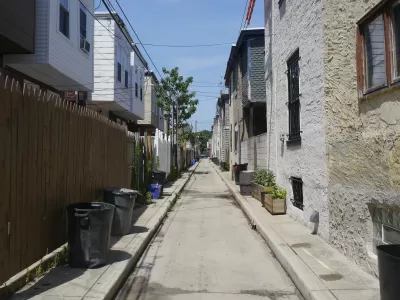
Like their counterparts elsewhere, most of Philadelphia's alleyways aren't very beloved spaces. "In a Center City Residents' Association (CCRA) newsletter, [blogger William] West described the alleyways as an 'inartful jumble of architectural afterthoughts.'"
West proceeded to rank the city's alleys according to their quality. Middle scorers have the most to gain from an easy face-lift. "Subsequently, Moravian Street was selected as the best middle-ground contender. Moravian was also appropriate due to its location—it is situated between two of the most popular retail blocks in the city."
Moravian Street will be transformed, it is hoped, into an attractive urban space. "Simple green plantings with shrubbery and bushes create a sense of place, while murals integrated with green walls, hanging lights and bird boxes round out the design. Now, one can easily imagine this as a place that has grown over time, not just an alleyway with some plants hastily chucked in."
Read the full story: Phill'd In

How Placemaking Lost its Way — And How it Can Get Back on Track
The term has often become diluted, getting attached to projects that don’t live up to its lofty aspirations.
String Lights are Secular! The Holiday Case for Year-round Placemaking
The holidays make streets and spaces warm, cozy, and welcoming. Why don’t we do that year round?
Placekeeping: Setting a New Precedent for City Planners
How a preservation-based approach to redevelopment and urban design can prevent displacement and honor legacy communities.

Planetizen Federal Action Tracker
A weekly monitor of how Trump’s orders and actions are impacting planners and planning in America.

California plans to bury El Niño’s downpour
If the state plays its cards right, it may be able to store a billion acre-feet of El Niño’s water in aquifers.

Chicago breaks ground on $3 billion megadevelopment
The new neighborhood, titled Foundry Park, will one day host 3,700 residences.

Desperate measures: Advocates weigh draining Lake Powell to fill Colorado River
Draining the reservoir could reduce evaporation losses by a couple hundred thousand acre-feet.

This road in NYC is infamously dangerous — and Mamdani can't fix it
New York City's Ocean Parkway is known for reckless driving, but the power to implement safety measures lies with the state rather than the city.

One of Denver’s busiest corridors to gain BRT
The project will span 18 miles and contain 74 bus rapid transit stations.

FREE Course: Walkable City 1: Why Walkability?
After describing his path towards focusing on walkability as the essence of good planning, Jeff Speck marches through his five principal reasons for making more walkable places.
Reinventing Malls: Planning Alchemy—Turning Gray Fields Into Gold
The course focuses on the opportunities and imperatives that shape reinvention of mall sites.

City of Rosemead
Rutgers University, Edward J. Bloustein School of Planning and Public Policy
One Hundred Miles
Hunter College, City University of New York (CUNY)
The Architects Foundation
University of Cincinnati Online
City of Cambridge
Montrose County
The Pocatello Development Authority