Ambitious new emission reduction targets can be met with strategies that also help achieve other economic, social, and environmental objectives.



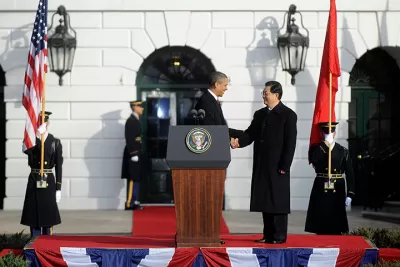
Yesterday, the United States and China announced that both countries will curb their greenhouse gas emissions over the next two decades. Under the agreement, the United States will reduce its carbon emissions 26-28 percent below the 2005 level by 2025, and China would peak its emissions by 2030 and aims to produce 20 percent of its energy from zero-carbon emission sources by that year.
Now, it's up to practitioners—policy advisers, planners, engineers, and designers—to identify suitable strategies for achieving these targets. Unfortunately, there is plenty of skepticism about climate change. Fortunately, there are plenty of good "win-win" policies that reduce emissions and achieve other economic, social, and environmental objectives. These are "no regrets" policy policies and programs which are justified regardless of the value placed on greenhouse gas emissions.
Here are some good information resources about them:
The Transport chapter of Intergovernmental Panel on Climate Change’s Climate Change 2014: Mitigation of Climate Change report examines potential strategies for reducing transportation climate change emissions. It concludes that a range of strong and mutually‐supportive policies will be needed to decarbonize the transport sector and fully exploit potential co‐benefits.
Cities: Engines of National and Global Growth is a chapter in a larger report by the New Climate Economy, a major international effort to identify policies that support economic development and climate change emission reductions and to identify various transport and land use strategies that support economic development and reduce emissions. It incorporates results from a soon-to-be released report I wrote, Analysis of Public Policies that Unintentionally Encourage and Subsidize Urban Sprawl, which was commissioned by the London School of Economics.
Urban Transport and Climate Change, by the Sustainable Urban Transport Project, summarises the challenges that climate change mitigation must face in the transport sector and presents strategies to deal with them. This is one of many excellent publications in the SUTP Sourcebook series.

A Global High Shift Scenario: Impacts And Potential For More Public Transport, Walking, And Cycling With Lower Car Use. This report by the Institute for Transportation and Development Policy explores the economic, social, and environmental impacts provided by a “high shift” urban transport scenario in which public policies (transport investments, pricing reforms and land use policies) encourage more walking, cycling, and public transport, and less driving, in cities around the world.
Land Transport’s Contribution To A 2°C Target: Key Messages On Mitigation Potential, Institutions And Financing Of Low-Carbon Land Transport For Policy Makers On Transport And Climate Change" by the Bridging the Gap Initiative and the Partnership on Sustainable, Low Carbon Transport identifies comprehensive strategies that can reduce transport GHG emissions and make substantial contributions to other objectives, such as air quality, safety, energy security, mobility access, and economic productivity, thereby supporting Sustainable Development Goals.
A Performance-Based Approach to Addressing Greenhouse Gas Emissions through Transportation Planning by the Federal Highway Administration provides information for transportation agencies to integrate greenhouse gas performance measures into transportation decision-making.
Health Co-Benefits Of Climate Change Mitigation - Transport Sector: Health In The Green Economy, by the World Health Organization, identifies potential health co-benefits of climate change mitigation strategies for transport, including benefits from reduced traffic accident risks and pollution emissions, and increased physical exercise and access.
Win-Win Solutions to Climate Change and Transport by the United Nations Centre for Regional Development identified ways that developing country cities can avoid the inefficiencies of excessive automobile dependency, and leap-frog into more efficient and equitable urban design.
These and other resources indicate that the emission reduction targets can be achieved with strategies that also support true economic development, social equity, and quality of life. I will be discussing these issues next week in my presentation at the Eighth Regional Environmentally Sustainable Transportation (EST) Forum in Asia, in Colombo, Sri Lanka. Policy makers there are serious about climate change emission reductions, and fortunately, we have good solutions to offer.
The future is in our hands. Let the planning begin!

Implications for Planning Emerge From COP21
The Conference of Parties (COP21) held during the last two weeks in Paris establishes ambitious climate change emission reduction targets. This will be a challenge and opportunity for planners. Here are some highlights.
Yes, We Can Have a Healthy Environment and Economic Development: Reconciling Conflicting Planning Objectives
I am sorry to report that, Canada, my chosen country (I immigrated here in 1993), recently withdrew from the Kyoto Accord, which sets international climate change emission reduction targets. It’s worth noting that this decision was made...
Win-Win Transportation Emission Reduction Strategies: Good News for Copenhagen
Here is good news for anybody looking for smart ways to reduce climate change. "Win-Win" transportation emission reduction strategies can provide substantial energy conservation and emission reductions in ways that also help achieve economic and social objectives.

Planetizen Federal Action Tracker
A weekly monitor of how Trump’s orders and actions are impacting planners and planning in America.

California plans to bury El Niño’s downpour
If the state plays its cards right, it may be able to store a billion acre-feet of El Niño’s water in aquifers.

Desperate measures: Advocates weigh draining Lake Powell to fill Colorado River
Draining the reservoir could reduce evaporation losses by a couple hundred thousand acre-feet.

Chicago voters approve permanent festival grounds, penalty for vacant property owners
Currently, major summer and fall festivals take over public parks for weeks at a time, drawing criticism from nearby residents

NYC votes to cut outdoor dining red tape, speed up permitting
New York City also voted to allow the Department of Transportation to begin work on urgent projects before notifying elected officials.

California appears to reject Prop. 45
The proposition would have expanded the projects that qualify for a streamlined environmental review, effectively paring down the California Environmental Quality Act.

FREE Course: Walkable City 1: Why Walkability?
After describing his path towards focusing on walkability as the essence of good planning, Jeff Speck marches through his five principal reasons for making more walkable places.
Reinventing Malls: Planning Alchemy—Turning Gray Fields Into Gold
The course focuses on the opportunities and imperatives that shape reinvention of mall sites.

City of Rosemead
Rutgers University, Edward J. Bloustein School of Planning and Public Policy
One Hundred Miles
Hunter College, City University of New York (CUNY)
The Architects Foundation
University of Cincinnati Online
City of Cambridge
Montrose County
The Pocatello Development Authority

