What should graduate students read the summer before entering planning school? For those with some time on their hands the following suggestions can help provide direction.



What should graduate students read the summer before entering planning school? Perhaps because I’m now the director of a graduate planning program I get asked this quite a bit. This is a hard question to answer. If admitted students are busy working in planning, being planning activists, or making money to support their graduate studies there may not be much time for reading. This is fine as graduate courses will lead students through a set of readings in a structured manner. However, for those with some time on their hands the following suggestions can help provide direction.
Read a set of classic articles in planning theory. This is a subfield within planning dealing with the justification of planning, planning ethics, planning and politics, and the role of planning in society. A book like Readings in Planning Theory, edited by Susan Fainstein and Scott Campbell, provides a very good overview of such articles. Such books can be picked up used for around $25 and are a good investment.
Read some classic books in the area of planning. Planteizen’s Top 20 All-Time Urban Planning Titles is a reasonable place to start. I might quibble with some entries but these are all useful books.
For a list of readings compiled by students, try the Planners Network Disorientation Guide. They have a media and book list on pages 13-16.
In the past in response to this kind of request I also compiled lists of city and metropolitan plans and famous places.
Finally I might put in a plug for my previous advice columns, indexed at http://annforsyth.net/for-students/advice/.

University of Michigan launches urban technology master's program
The program explores how technology can help planners, architects, and others make cities more environmentally and socially sustainable.

Applying to Graduate School in Planning: A Second Update
In 2008 and 2018, I wrote some much-read blogs about how to get into planning school. As deadlines near, I revisit that advice. I look first at the big picture of the case you need to make for the admissions committee and then the logistics.

Seoul’s Urban Parks Blossom with Books
The Reading in Seoul Garden event invited residents to enjoy free reading and relaxation activities, including digital and live programs, in scenic parks, fostering a sense of community amid the city’s autumn landscapes.

Planetizen Federal Action Tracker
A weekly monitor of how Trump’s orders and actions are impacting planners and planning in America.

‘Going backwards:’ Baltimore mayor, students rally against state's transit funding plan
Maryland's proposed six-year plan provides no funding for Baltimore’s BMORE bus program and reduces its road maintenance funding.

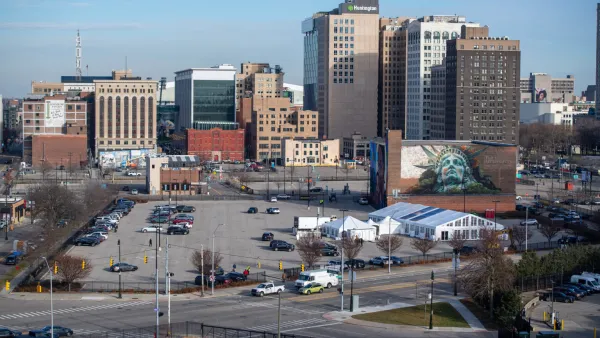
Detroit to transform waterfront with $2.2 billion investment
Developers will convert about 18 acres of unused parking lot space into civic spaces.

Data center developers are using lawsuits, cash offers to ‘overwhelm’ rural America
Newsrooms in five states worked together to uncover the tactics big tech developers use to buy land from reluctant communities.

U.S.-Iran war may have ‘devastating’ impact on cost to warm homes
Vermont and Maine residents may see a 76% increase in the cost of warming their homes this winter.

Senate bill would ‘overhaul’ environmental permitting laws
Under the proposed act, government agencies would also not be able to suspend or rescind permits after granting them.

FREE Course: Walkable City 1: Why Walkability?
After describing his path towards focusing on walkability as the essence of good planning, Jeff Speck marches through his five principal reasons for making more walkable places.
Reinventing Malls: Planning Alchemy—Turning Gray Fields Into Gold
The course focuses on the opportunities and imperatives that shape reinvention of mall sites.

One Hundred Miles
County of Mendocino
planning NEXT
The Architects Foundation
University of Cincinnati Online
Montrose County
Northern Illinois Transit Authority (NITA)
The Pocatello Development Authority

