John Metcalfe looks at how one Japanese company is advancing a more quieter sensitive method for demolishing high-rise buildings, floor by floor.


"Leave it to Japan to turn one of the dirtiest and noisiest processes of the urban lifecycle – the demolition of highrises – into a neat, quiet and almost cute affair," says Metcalfe. And in the video below you can see the innovative "Taisei Ecological Reproduction" system being deployed by Japanese construction company Taisei to demolish the Grand Prince Hotel Akasaka in Tokyo.
"Basically," explains Metcalfe, "construction workers build a hermetic structure covering the top floors of a tower that is supported by powerful jacks. Inside the structure are the heavy machines and demolition crews, who take apart the walls and cut the floors into concrete slabs that they lower to the ground via interior cranes. When they finish removing one floor, the jacks move the 'big hat' to the next one down, creating the impression for outside observers that a huge, disembodied mouth is consuming the tower from the top down."
Among the benefits of this method of de-construction: reducing dust pollution by 90 percent, muffling noise pollution, and powering the lights and machinery on the construction site through regenerative braking. Plus, it looks pretty funny in a time lapse video.
Read the full story: Knocking Down Huge Buildings Quietly, Floor by Floor

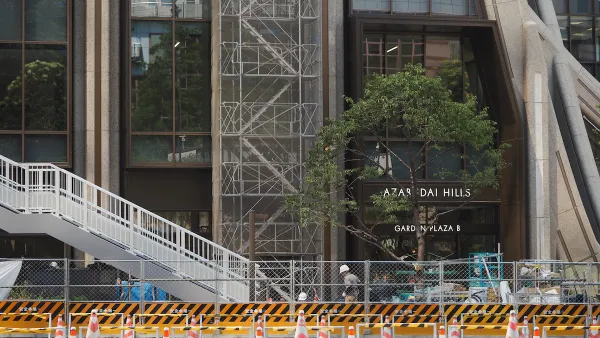
A New Tallest Skyscraper for Japan
The Toranomon-Azabudai reaches 330 meters into the sky, far lower than international standards but taller by 30 meters than the previous tallest building in Japan.
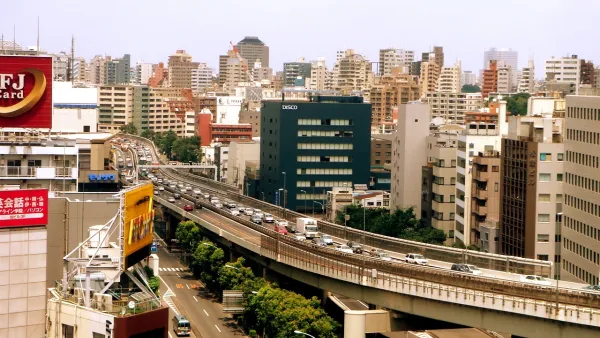
Tokyo Expressway to Become a Linear Park
A major expressway in Ginza will be converted to a park similar to New York City's High Line.
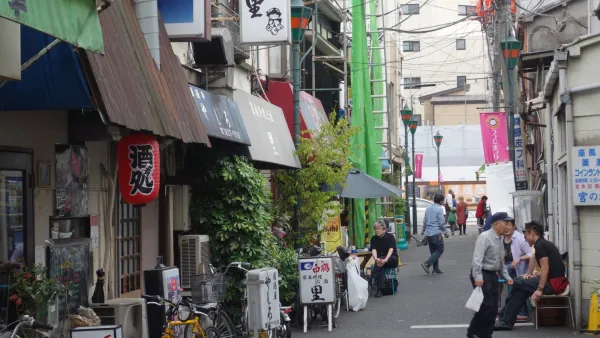
A Different Kind of Density: Lessons From Asian Megacities
As the pandemic has made clear, a healthy, prosperous future will depend on the development of the kinds of density that encourage strong social infrastructure.

Planetizen Federal Action Tracker
A weekly monitor of how Trump’s orders and actions are impacting planners and planning in America.

Amtrak, CN end decades-long dispute with eight-year agreement
The new operating agreement establishes an updated framework for the companies to work together, including processes to resolve disputes.

Judges permit Denver to divert 77,000 acre feet from the Colorado River for reservoir expansion
Overuse and climate change have caused the Colorado River’s water levels to plummet.

NYC DOT wants faster, more permanent street upgrades
The city is examining ways to build more concrete infrastructure without getting entangled in 'decades-long' projects.

'Something we’ve never seen before:' rising utility rates could strain city finances nationwide
Data centers, climate change and other factors have caused utility rates in the United States to increase by 38% since 2020.

Trump to overrule local leaders, lease millions of acres of America’s Pacific Island territories’ seafloors to mining companies
International law says that the Indigenous people of America’s territories have a right to prior and informed consent regarding projects that impact their countries.

FREE Course: Walkable City 1: Why Walkability?
After describing his path towards focusing on walkability as the essence of good planning, Jeff Speck marches through his five principal reasons for making more walkable places.
Reinventing Malls: Planning Alchemy—Turning Gray Fields Into Gold
The course focuses on the opportunities and imperatives that shape reinvention of mall sites.

Harvard University Graduate School of Design
KFH Group Inc.
Greater Baltimore Committee
The Architects Foundation
University of Cincinnati Online
The Pocatello Development Authority
The Urban Renewal Agency of the City of Pocatello