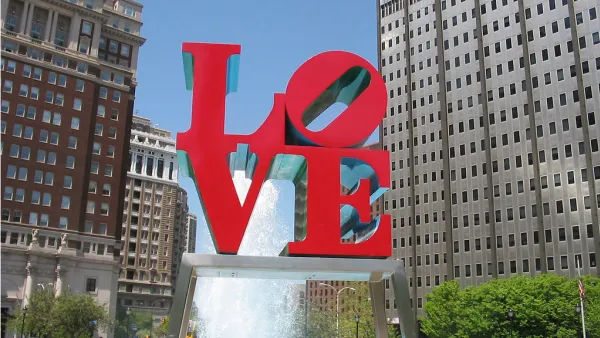
Philadelphia may lose its world-famous skateboarding landmark with the renovation of its LOVE Park plaza, flaring a decade-old debate that has made international headlines.


Philadelphia's LOVE Park, a dead plaza in the 1980s, was brought back to life by skateboarding, transforming this downtown plaza into an international hub of a multi-billion-dollar sport. When the City enforced a skateboarding ban back in 2002, a coalition of advocates raised over $1 million, gained 10,000 petition signatures from 40 nations, and editorials in the city's major daily newspapers in support of re-opening the park to skateboarding.
Because of LOVE Park, Philadelphia hosted the X Games two years in a row and was home to some of the nation's top professional skateboarders. However, City government turned down a $1 million from California-based DC Shoes to reopen the park to skateboarding. The city is now moving ahead on renovating the plaza to discourage skateboarding. The issue is at the heart of a larger debate around the acceptability of skateboarding as part of a mixed-use urban environment.
Thanks to Greg Heller
Read the full story: Philadelphia has one last chance for skateboarding at LOVE Park

Skateboarding Is Good for Cities, But Some Cities Don't Realize It
Some cities treat skateboarders like a plague, and that's a planning faux pas, according to this article.
Review: Philadelphia's Iconic Love Park Gets a Major Makeover
Architecture Critic Inga Saffron gives a less-than-stellar review of the newly revealed revamp of Philadelphia's Love Park.
Details Emerge for Philadelphia's LOVE Park Redo
One of the country's most scrutinized and anticipated renovation projects, Philadelphia's LOVE Park, has been unveiling critical design decisions in recent weeks.

Planetizen Federal Action Tracker
A weekly monitor of how Trump’s orders and actions are impacting planners and planning in America.

California plans to bury El Niño’s downpour
If the state plays its cards right, it may be able to store a billion acre-feet of El Niño’s water in aquifers.

Desperate measures: Advocates weigh draining Lake Powell to fill Colorado River
Draining the reservoir could reduce evaporation losses by a couple hundred thousand acre-feet.

Mamdani’s pied-à-terre tax survives legal challenge
A panel of judges found that the plaintiffs failed to demonstrate injury as a result of New York City's implementation of the tax.

Eastern Nebraska is running out of electricity
Data centers and electrification are straining eastern Nebraska’s grid, throttling economic development.

Seattle passes record-breaking transit services expansion
Proposition 1 will double the city’s transit tax to add 95,000 more bus trips and preserve 180,000 bus trips annually.

FREE Course: Walkable City 1: Why Walkability?
After describing his path towards focusing on walkability as the essence of good planning, Jeff Speck marches through his five principal reasons for making more walkable places.
Reinventing Malls: Planning Alchemy—Turning Gray Fields Into Gold
The course focuses on the opportunities and imperatives that shape reinvention of mall sites.

City of Rosemead
Rutgers University, Edward J. Bloustein School of Planning and Public Policy
One Hundred Miles
University of Michigan School for Environment and Sustainability (SEAS)
Hunter College, City University of New York (CUNY)
The Architects Foundation
City of Cambridge
Montrose County
The Pocatello Development Authority