BrandWeek says that the downturn in the economy makes more ads in public spaces 'a no-brainer', because cities get revenue and advertisers get exposure in previously untapped locations.


"Every day, hundreds of jets lift off from Runway 33 of the George Bush Intercontinental Airport, laying trails of gray exhaust across the muggy Houston sky. The planes climb steeply toward cruising altitude, and by the time they're over the northern suburb of Humble, everything on the ground looks pretty small. Even the huge billboards that dot the city's metro area are difficult to see. The lone exception is the roof of Humble High School. It's a perfect 160,000-sq.-ft. box. And if Cynthia Calvert has her way, it will soon have an ad on it.
"We're looking for an advertiser who wants to be under all those people," she says. "We have found a company that'll paint it." And what will the school get from surrendering the very roof over its head? Calvert can't put it more plainly: "Found money," she says.
Calvert runs a new company called Steep Creek Media, which also is looking to sell ads in the school's parking lot, its stadium, and even at the bottom of its swimming pool. If her ideas raise eyebrows, here's another fact to ponder: If and when Humble High finds its advertisers, it'll hardly be unique. Across our recessionary land, cash-strapped municipalities-their coffers depleted by a dwindling tax base-are suddenly in marketing mode, chumming up with companies ready to pay for the honor of having their ad, name or logo on a high-visibility civic property."
Read the full story: Why You'll Be Seeing More Ads in Public Spaces


Artists Find Alternate Uses for Billboards in Los Angeles
With a surplus of unsold billboard spaces dotting Los Angeles, artists are using the empty spaces as canvasses for new forms of public art.
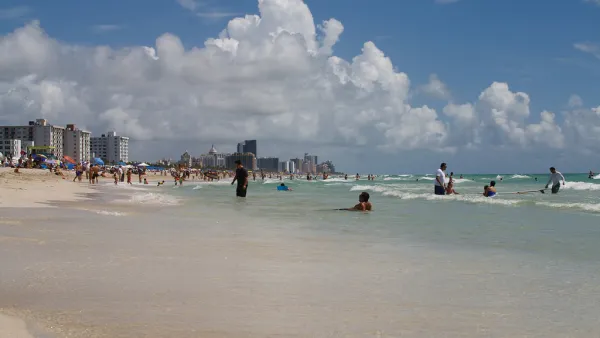
Miami Beach's Floating Billboards: A Nuisance on Water
The picturesque ocean front of Miami Beach is being sullied by digital billboards now floating off shore on boats, outside the reach of the city's authority.
Private and Public Converge in Toronto's 'Information Pillars'
New street furniture is being installed in Toronto, but locals are already sick of it. They're called "information pillars" and are supposed to offer helpful directions and info to pedestrians, but critics complain that they're mostly advertisements.

Amtrak, CN end decades-long dispute with eight-year agreement
The new operating agreement establishes an updated framework for the companies to work together, including processes to resolve disputes.

Northwest rail fans eager for Sept. 30 debut of Amtrak’s Airo fleet
Get ready for that new train smell and more seats. But they won’t go faster or run more frequently on the Cascades route in Washington and Oregon.

Judges permit Denver to divert 77,000 acre feet from the Colorado River for reservoir expansion
Overuse and climate change have caused the Colorado River’s water levels to plummet.

NYC to turn city-owned property into thousands of homes
The city has scheduled a public hearing regarding the development for October.

Buses travel at 5mph along this route in NYC. The Bronx's first-ever busway looks to change that
Prior to the busway, buses on the Bx36 route traveled as slowly as 5 miles per hour.

Pittsburg launches 'EZ permits,' aims for one-day turnaround for low-risk permits
The pilot ‘fast lane’ for permits is part of a bundle of modernization efforts for Pittsburg’s permitting process.

FREE Course: Walkable City 1: Why Walkability?
After describing his path towards focusing on walkability as the essence of good planning, Jeff Speck marches through his five principal reasons for making more walkable places.
Reinventing Malls: Planning Alchemy—Turning Gray Fields Into Gold
The course focuses on the opportunities and imperatives that shape reinvention of mall sites.

City of Thousand Oaks
City of Wisconsin Rapids
Harvard University Graduate School of Design
The Architects Foundation
University of Cincinnati Online
The Pocatello Development Authority
The Urban Renewal Agency of the City of Pocatello