With roughly 10,000 foreclosures in the last two years, Cleveland has been hit hard by the economic crisis.


"Vacant houses are not a new phenomenon to the city. Ravaged by the closing of American steel mills, Cleveland has long been in decline. With fewer manufacturing jobs to attract workers, it has lost half its population since 1960. Its poverty rate is one of the highest in the nation. But in all those years, nothing has approached the current scale of ruin.
And in December, just when local officials thought things couldn't get worse, Cuyahoga County, which includes Cleveland, posted a record number of foreclosure filings. The number of empty houses is so staggeringly high that no one has an accurate count. The city estimates that 10,000 houses, or 1 in 13, are vacant. The county treasurer says it's more likely 15,000. Most of the vacant houses are owned by lenders who foreclosed on the properties and by the wholesalers who are now sweeping in to pick up houses in bulk, as if they were trading in baseball cards."
Read the full story: All Boarded Up

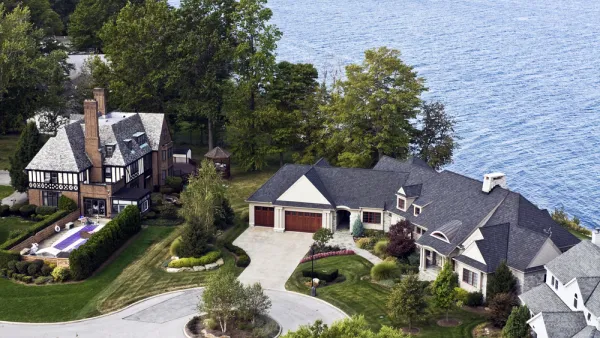
Effects of the Foreclosure Crisis Still Felt in Parts of Cleveland
Call it a tale of two housing markets.
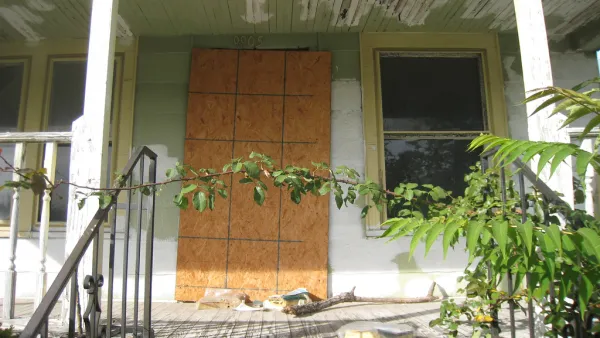
Cleveland Still Experiencing Fallout From Great Recession
National economic indicators may look good, but some areas are still clawing their way back from the 2008 recession. Cleveland's Slavic Village, an "epicenter" of the foreclosure crisis, is one of them.
Terms and Concepts for Understanding Land Banks
Clarifying some of the jargon that drives the land bank process in Cuyahoga County, Ohio reveals the importance and scale of neighborhood stabilization in some parts of the country.

Planetizen Federal Action Tracker
A weekly monitor of how Trump’s orders and actions are impacting planners and planning in America.

Amtrak, CN end decades-long dispute with eight-year agreement
The new operating agreement establishes an updated framework for the companies to work together, including processes to resolve disputes.

Judges permit Denver to divert 77,000 acre feet from the Colorado River for reservoir expansion
Overuse and climate change have caused the Colorado River’s water levels to plummet.

Philadelphia to invest $2 billion into upgrading city airports as PHL places last in customer satisfaction
Modernizations to Philadelphia's airports will include baggage system upgrades and a new automated parking garage guidance system.

The LA housing policies making developers turn away from the city
Despite LA’s housing shortage, developers say the city’s "mansion-tax" and pandemic-era policies make it an unappealing place to build housing.

New density bill would require 7 California cities to establish regional transit hubs
The bill would also require major cities in California to permit high-rise residential buildings.

FREE Course: Walkable City 1: Why Walkability?
After describing his path towards focusing on walkability as the essence of good planning, Jeff Speck marches through his five principal reasons for making more walkable places.
Reinventing Malls: Planning Alchemy—Turning Gray Fields Into Gold
The course focuses on the opportunities and imperatives that shape reinvention of mall sites.

City of Wisconsin Rapids
Harvard University Graduate School of Design
KFH Group Inc.
The Architects Foundation
University of Cincinnati Online
The Pocatello Development Authority
The Urban Renewal Agency of the City of Pocatello