A new reports says high gas prices have contributed to falling house prices in the nation's suburbs.


"First it was the faltering economy. Then came rising commodity prices.
Can steadily increasing gas prices also be blamed for bursting the housing bubble?
Yes, says Portland economist Joe Cortright of Impresa Inc. "The gas price spike popped the housing bubble," he writes in a new report called "Driven to the Brink."
The report, funded by CEOs for Cities, a pro-urban Chicago-based nonprofit, advances an argument gaining steam in national urban planning circles: Rising gas prices have made it less attractive to live in suburban neighborhoods that require driving to work, shop and fun.
In metro areas where home prices are falling, they're falling more steeply in suburbs than in central areas. In metro areas with strong inner city neighborhoods -- like Portland -- prices of centrally located homes continue to rise while the region's prices fall.
That observation also came up during an Urban Land Institute presentation Tuesday in Washington, D.C., on infrastructure investment.
But economists disagree about the role gas prices may have played in the housing downturn. Most say the mortgage lending crunch, overbuilding by homebuilders and speculation by investors played larger roles."
Read the full story: Spike in gas prices help burst housing bubble, a Portland economist suggests

Gas Prices Hurting Housing Market
The bursting of the housing bubble may be tied to rising gas prices, according to one economist.

Two out of three transit riders in Las Vegas don't own a car
As gas and insurance prices rise, car commuting is becoming more unaffordable to working Americans, leaving them reliant on their local transit systems.
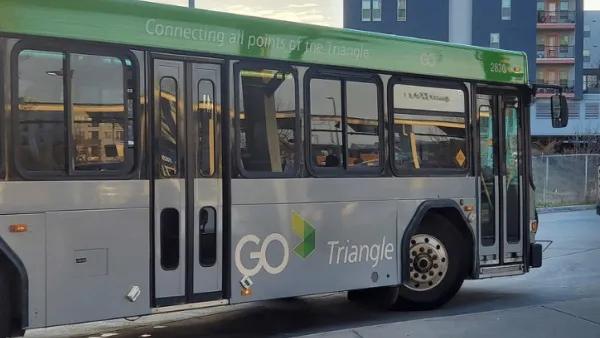
North Carolina Triangle transit ridership jumped 32% in April
Rising gas prices are prompting more Americans to consider public transit, where it's available.

Planetizen Federal Action Tracker
A weekly monitor of how Trump’s orders and actions are impacting planners and planning in America.

Amtrak, CN end decades-long dispute with eight-year agreement
The new operating agreement establishes an updated framework for the companies to work together, including processes to resolve disputes.

Judges permit Denver to divert 77,000 acre feet from the Colorado River for reservoir expansion
Overuse and climate change have caused the Colorado River’s water levels to plummet.

NYC DOT wants faster, more permanent street upgrades
The city is examining ways to build more concrete infrastructure without getting entangled in 'decades-long' projects.

'Something we’ve never seen before:' rising utility rates could strain city finances nationwide
Data centers, climate change and other factors have caused utility rates in the United States to increase by 38% since 2020.

Trump to overrule local leaders, lease millions of acres of America’s Pacific Island territories’ seafloors to mining companies
International law says that the Indigenous people of America’s territories have a right to prior and informed consent regarding projects that impact their countries.

FREE Course: Walkable City 1: Why Walkability?
After describing his path towards focusing on walkability as the essence of good planning, Jeff Speck marches through his five principal reasons for making more walkable places.
Reinventing Malls: Planning Alchemy—Turning Gray Fields Into Gold
The course focuses on the opportunities and imperatives that shape reinvention of mall sites.

Harvard University Graduate School of Design
KFH Group Inc.
Greater Baltimore Committee
The Architects Foundation
University of Cincinnati Online
The Pocatello Development Authority
The Urban Renewal Agency of the City of Pocatello