The Silicon Valley city is seeking a state designation that offers access to state housing funds.



Palo Alto is applying for a California state "pro-housing" designation that would unlock millions in state grants for housing projects, reports Riley Cooke in Palo Alto Online. "In a sign of the times, the City Council agreed at its priority-setting retreat this year to pursue the state’s pro-housing designation."
According to Cooke, "The application requires cities to explain how they are exceeding state standards for encouraging housing production through local policies, which are divided into four broad categories: favorable zoning and land use, streamlined permitting, cost reduction, and financial subsidies for affordable housing."
The city, which is working to shift its historically resistant attitude to new housing, cited a number of recent pro-density policies including the planned creation of a new residential community in a historically commercial area. Acknowledging the city's reputation for NIMBYism, "Commissioner Todd James made a point that earning the designation has not just practical benefits, but reputational ones as well."
FULL STORY: Once known for resisting growth, Palo Alto now seeks ‘pro-housing’ designation

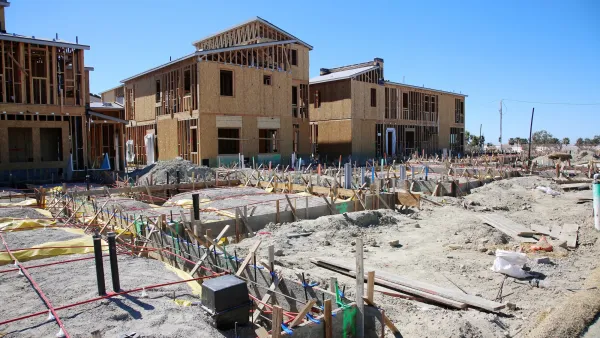
Less than 6% of California cities are building enough housing for very low-income households
Only five jurisdictions are on track to meet their housing goals for all income brackets.

LA delays state housing mandate with 'low-rise ordinance'
The new ordinance allows the city to delay implementing SB 79, a state law requiring more density near transit.

The trouble with QUIMBY, revisited — a rebuttal to a rebuttal
In a perfect world, QUIMBY might get us a bit closer where we need to go. But, this YIMBY argues, not close enough.

Planetizen Federal Action Tracker
A weekly monitor of how Trump’s orders and actions are impacting planners and planning in America.

The state-sanctioned urbicide of Austin
People don’t kill cities. Freeways do.

US to reduce Colorado River water deliveries to Mexico
A new Colorado Treaty amendment reduces Mexico’s Colorado River water allocation by 250,000 acre feet.

Mamdani overhauls NYC's Vision Zero plan with 100 new policy goals
The overhaul aims to reduce traffic deaths and make streets safer for pedestrians, cyclists and drivers through lower speed limits, new safety infrastructure and more.

Amtrak not solely to blame for New Jersey commuter rail's unreliability, report finds
A new study from the Garden State Initiative found that NJ Transit’s budget grew 20% across a 4 year period, but reliability declined significantly over the same period.

EPA erases limits on planet-warming pollution from power plants
Under Monday’s plan, power plants would still have some limits on how much mercury, arsenic and other contaminants they can emit.

FREE Course: Walkable City 1: Why Walkability?
After describing his path towards focusing on walkability as the essence of good planning, Jeff Speck marches through his five principal reasons for making more walkable places.
Reinventing Malls: Planning Alchemy—Turning Gray Fields Into Gold
The course focuses on the opportunities and imperatives that shape reinvention of mall sites.

Eagle County Government
Harvard University Graduate School of Design
Nashville Planning Department
The Architects Foundation
University of Cincinnati Online
The Pocatello Development Authority
The Urban Renewal Agency of the City of Pocatello
Journal of the American Planning Association