The 'Big Night' brings out volunteers to help frogs, salamanders, and other migrating amphibians cross roads to reach their breeding grounds.


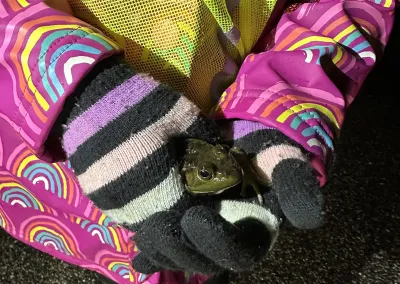
Every spring, volunteers gather on roadways in Maine to monitor frogs and salamanders as they cross the road on their annual migration to the vernal pools where they lay their eggs.
As Grace Benninghoff explains in Grist, climate change has made the trip more dangerous, and the volunteers are there to track the animals and understand how many are surviving the trek. "Coordinated by Maine Big Night, the effort, which came on April 14 this year, is generating data that is reshaping how communities think about culverts, road maintenance, and other infrastructure."
While the group of volunteers started out just guarding the road as the animals crossed, a nonprofit has now asked them to document their observations at 650 migration sites statewide. "When data last year showed that eight out of 10 amphibians were hit by motorists in Orono, at the state’s most ecologically diverse migration site, Big Night worked with city officials to secure a grant for cameras and fencing that guide the animals toward an existing culvert beneath the road. When the group also saw rising numbers with edema linked to road salt runoff, it pushed for alternative deicing methods, including pickle juice."
According to Benninghoff, "Good data does more than help amphibian advocates win protections. It ensures conservationists spend limited resources where they’ll do the most good." The animals are crucial to New England's ecosystem, sustaining a wide range of larger animals.
FULL STORY: One night a year, humans command this march of frogs and salamanders


San Diego Sues DHS, DOD Over Razor Wire Near Mexico Border
The city says U.S. Marines trespassed on city land to install fencing that damages sensitive habitat in an area designated as conservation land.
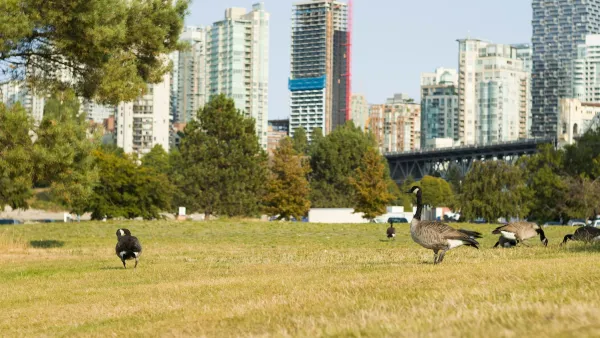
Study: How Urban Parks Can Support Biodiversity
Conservation and recreation can go hand in hand in urban green spaces designed to serve both humans and local wildlife.
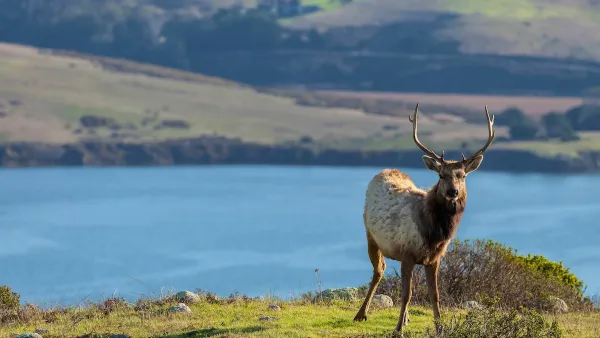
Celebrating California's Biodiversity
This year marks the fifth annual California Biodiversity Day, established in 2018 to celebrate and encourage actions to protect the state’s exceptional biodiversity.

Planetizen Federal Action Tracker
A weekly monitor of how Trump’s orders and actions are impacting planners and planning in America.

The state-sanctioned urbicide of Austin
People don’t kill cities. Freeways do.

US to reduce Colorado River water deliveries to Mexico
A new Colorado Treaty amendment reduces Mexico’s Colorado River water allocation by 250,000 acre feet.

5 New England states march closer to 800 megawatt wind energy project
Securing federal approval for the project may be complicated under the Trump administration, which has historically been hostile towards domestic wind power.

Baltimore to break ground on $50 million Transit Priority Project
The project will bring faster bus trips, safer streets and better bike connections to Baltimore.

Airbnb launches $250 million 'last-dollar financing' housing accelerator, makes first investment in Austin
The company will put $6.4 million towards affordable housing development in Texas’ capital.

FREE Course: Walkable City 1: Why Walkability?
After describing his path towards focusing on walkability as the essence of good planning, Jeff Speck marches through his five principal reasons for making more walkable places.
Reinventing Malls: Planning Alchemy—Turning Gray Fields Into Gold
The course focuses on the opportunities and imperatives that shape reinvention of mall sites.

Eagle County Government
Harvard University Graduate School of Design
Nashville Planning Department
The Architects Foundation
University of Cincinnati Online
The Pocatello Development Authority
The Urban Renewal Agency of the City of Pocatello
Journal of the American Planning Association