Virginia offered Amazon up to $750 million in public subsidies in exchange for creating local jobs and investment.


When Amazon built its 'HQ2' headquarters in Northern Virginia, it promised to create 25,000 new jobs by 2038. Per an agreement with the state, the company should have added 11,643 jobs by the end of 2025.
According to a Washington Post article by Kendall Staton, the company claimed economic forces beyond its control affected its ability to staff up faster. Amazon was offered up to $750 million in incentives as part of its permit to build the complex, which was the culmination of a competitive process that saw multiple cities vying for the project. Holly Sullivan, Amazon’s vice president of worldwide economic development policy, said "The company has invested millions in multiple education initiatives across the state and has donated more than $239 million to local groups since 2018, including more than $60 million in the past year."
However, the company is now only "moderately confident" that it will create as many jobs as it promised. Amazon has also failed to develop a large vacant lot it originally planned to build on by the end of 2025.
Read the full story: Amazon is behind on jobs promised for funding to build Virginia headquarters

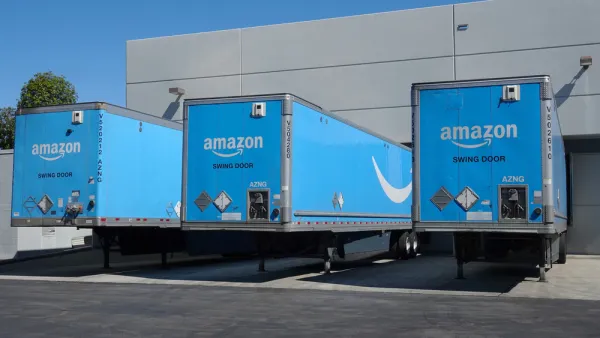
Key Warehouse Centers Challenge Distribution Center Expansion
Communities near major e-commerce distribution centers are increasingly resisting new construction, citing air pollution and other public health impacts.

Amazon Plans Further Expansion
On the heels of building its HQ2 facility in Arlington, Amazon continues to expand its hubs in cities spread out across the country.
Warehouse Sprawl Prompts Calls for Regional Planning
As e-commerce giants like Amazon build more and more facilities, advocates say a regional approach is needed to prevent sprawl and look beyond local benefits.

Planetizen Federal Action Tracker
A weekly monitor of how Trump’s orders and actions are impacting planners and planning in America.

California plans to bury El Niño’s downpour
If the state plays its cards right, it may be able to store a billion acre-feet of El Niño’s water in aquifers.

Chicago breaks ground on $3 billion megadevelopment
The new neighborhood, titled Foundry Park, will one day host 3,700 residences.

California High-Speed Rail Authority CEO resigns after $600,000 scandal
Under Ian Choudri, the authority used taxpayer dollars to fund first class flights and trips to nightclubs.

Want to study the Missouri River? Soon, you may need unanimous approval from 10 states
Legislation would require 10 governors’ permission to study or build projects moving water outside the basin.

Desperate measures: Advocates weigh draining Lake Powell to fill Colorado River
Draining the reservoir could reduce evaporation losses by a couple hundred thousand acre-feet.

FREE Course: Walkable City 1: Why Walkability?
After describing his path towards focusing on walkability as the essence of good planning, Jeff Speck marches through his five principal reasons for making more walkable places.
Reinventing Malls: Planning Alchemy—Turning Gray Fields Into Gold
The course focuses on the opportunities and imperatives that shape reinvention of mall sites.

City of Rosemead
Rutgers University, Edward J. Bloustein School of Planning and Public Policy
One Hundred Miles
Hunter College, City University of New York (CUNY)
The Architects Foundation
University of Cincinnati Online
City of Cambridge
Montrose County
The Pocatello Development Authority