Churches need parking, but most of their lots are wasted space six days a week.


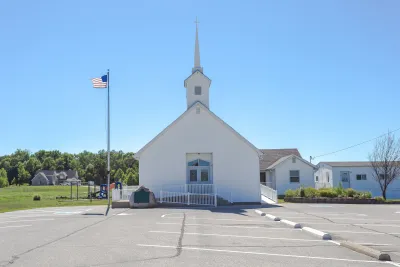
In a piece in Strong Towns, Adeleine Geitner outlines how church parking lots, which often take up valuable space in downtowns and city centers, can be utilized as public spaces during off hours.
As Geitner explains, it would be difficult for many U.S. churches to get rid of parking altogether. After all, they need it for their congregants, who, in many cases, have no option but to drive there. “If religious institutions will continue to build parking so long as their congregation demands it, and their congregation will continue to demand it in the absence of any drastic change to the residential landscape of the city, the most pressing question is not how can cities require less parking for religious institutions but instead how can this parking serve the community seven days a week?”
Geitner offers three potential solutions: let other organizations or the city use the parking lot for parking on days that the church doesn’t need it; cover the parking lot with grass instead of pavement so it can be used as a multipurpose field; and ‘kid-ify’ the parking lot with outdoor furniture, asphalt art, and other amenities that can transform it into a makeshift playground.
These options are just a start, Geitner adds. “The more minds there are thinking about the strange nature of church parking lots (they do fill up, but only a couple times a week), the more these parking lots have a chance of becoming better-used places.”
Read the full story: Separation of Church and Parking Lot
Who Wants to Play SimParkingLot?
The original urban planning game wanted to model real life cities. One grim reality of American urbanism held it back.
Opinion: Cities Must Take Action on Blighted Downtown Parking Lots
Surface parking lots take up as much as a third of downtown land in some cities, dragging down tax revenue and redevelopment prospects.
Des Moines Plans to Repurpose Downtown Parking Lots
City officials want to encourage the redevelopment of underused surface parking lots.

Planetizen Federal Action Tracker
A weekly monitor of how Trump’s orders and actions are impacting planners and planning in America.

California plans to bury El Niño’s downpour
If the state plays its cards right, it may be able to store a billion acre-feet of El Niño’s water in aquifers.

Desperate measures: Advocates weigh draining Lake Powell to fill Colorado River
Draining the reservoir could reduce evaporation losses by a couple hundred thousand acre-feet.

US buildings threatened, destroyed by fires set to triple by 2060
Researchers found a high fire risk for socioeconomically vulnerable neighborhoods in the American West.

LA residents may be allowed to paint their own crosswalks
Councilwoman Katy Yaroslavsky put out a motion instructing the Los Angeles Department of Public Transportation to study the feasibility of allowing volunteers to paint crosswalks.

Dallas moves to overhaul its zoning code
The city's zoning reform will allow more multi-family and mixed-use developments.

FREE Course: Walkable City 1: Why Walkability?
After describing his path towards focusing on walkability as the essence of good planning, Jeff Speck marches through his five principal reasons for making more walkable places.
Reinventing Malls: Planning Alchemy—Turning Gray Fields Into Gold
The course focuses on the opportunities and imperatives that shape reinvention of mall sites.

City of Rosemead
Rutgers University, Edward J. Bloustein School of Planning and Public Policy
One Hundred Miles
Hunter College, City University of New York (CUNY)
The Architects Foundation
University of Cincinnati Online
City of Cambridge
Montrose County
The Pocatello Development Authority