Trees for Houston works with private and public landowners to distribute trees across the city and help restore Houston’s shrinking tree canopy.


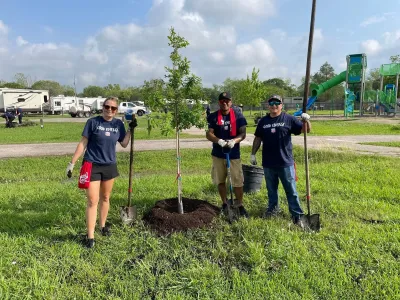
Nonprofit Trees for Houston planted its one millionth tree this month after four decades in operation. According to a piece by John Brannen in Urban Edge, the organization is ramping up their efforts. “Trees For Houston has dramatically scaled up its operations over the past several years, with the annual rate of trees planted rising from about 20,000 to more than 90,000 in the 2024-25 season.”
The organization, which partners with public and private landowners to distribute, plant, and maintain trees, hopes to plant its next million trees in the next 14 or 15 years. For Executive Director Barry Ward, the work is urgent — between 2011 and 2021, the vast majority of Harris County neighborhoods lost tree canopy to development or storms, according to a Kinder Institute analysis.
“Major greenspace projects like Discovery Green, the Cyvia and Melvyn Wolff Prairie at Memorial Park, and the addition of trees along highway embankments exemplify the potential for retaining canopy on a large scale, Ward said.” Trees for Houston also gave away roughly 65,000 trees to homeowners and organizations in the 2023-2024 season.
FULL STORY: With 1 million trees planted, Houston nonprofit charts expansion to combat canopy loss

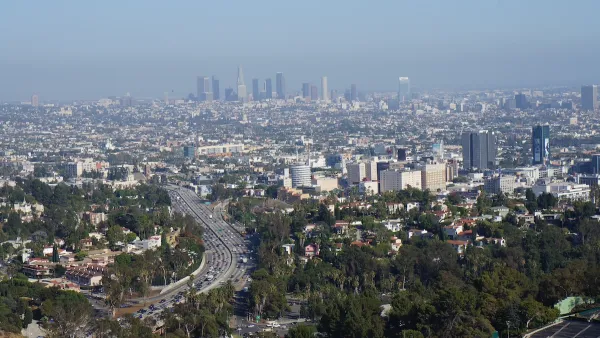
Updating LA’s Tree Rules Could Bring More Shade to Underserved Neighborhoods
A new USC study finds that relaxing Los Angeles’ outdated tree planting guidelines could significantly expand urban tree canopy and reduce shade disparities in lower-income neighborhoods, though infrastructure investments are also needed.
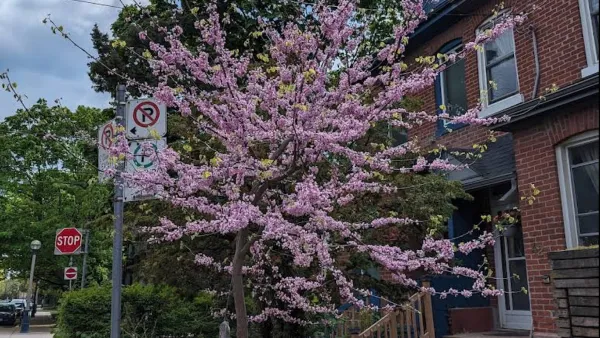
The Most Popular Tree on Google?
Meet Rodney: the Toronto tree getting rave reviews.
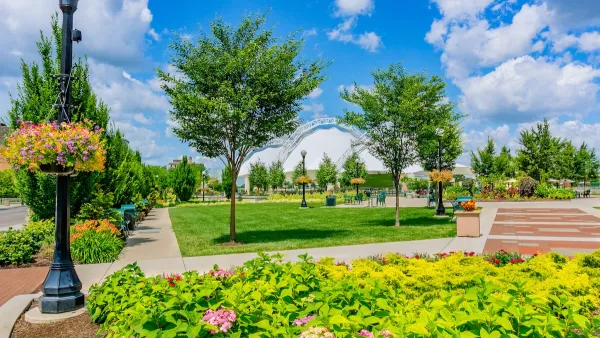
A Plan to Expand Tree Canopy Across Dayton
Dayton is developing an urban forest master plan, using a $2 million grant to expand its tree canopy, address decades of tree loss, and enhance environmental equity across the city.

The state-sanctioned urbicide of Austin
People don’t kill cities. Freeways do.

US to reduce Colorado River water deliveries to Mexico
A new Colorado Treaty amendment reduces Mexico’s Colorado River water allocation by 250,000 acre feet.

New Jersey’s second-largest city bans standalone data centers
Jersey City will continue to allow co-location facilities, such as those meant for research institutions that store their own data.

Amtrak not solely to blame for New Jersey commuter rail's unreliability, report finds
A new study from the Garden State Initiative found that NJ Transit’s budget grew 20% across a 4 year period, but reliability declined significantly over the same period.

EPA erases limits on planet-warming pollution from power plants
Under Monday’s plan, power plants would still have some limits on how much mercury, arsenic and other contaminants they can emit.

Phoenix announces new on-demand transit service, more frequent RAPID buses
Both new services will launch in October, and are part of Phoenix's Project Effective Access Solutions for Easing Congestion.

FREE Course: Walkable City 1: Why Walkability?
After describing his path towards focusing on walkability as the essence of good planning, Jeff Speck marches through his five principal reasons for making more walkable places.
Reinventing Malls: Planning Alchemy—Turning Gray Fields Into Gold
The course focuses on the opportunities and imperatives that shape reinvention of mall sites.

Eagle County Government
Harvard University Graduate School of Design
Nashville Planning Department
The Architects Foundation
University of Cincinnati Online
The Pocatello Development Authority
The Urban Renewal Agency of the City of Pocatello
Journal of the American Planning Association