Louisville is addressing its ongoing issues with climate change by investing in heat-tolerant tree species from southern regions to reduce rising temperatures and enhance its tree canopy coverage.


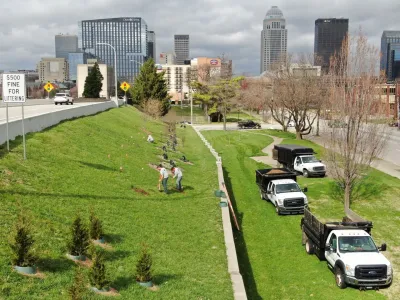
TreesLouisville, Louisville, Kentucky’s main non-profit organization dedicated to enhancing the city’s tree canopy, is altering its planting strategy by incorporating heat-tolerant tree species from the southern United States.
According to Connor Giffin of the Courier Journal, Louisville continues to face a dual environmental challenge: warmer summer temperatures and inadequate tree canopy coverage.
As Giffin reports, “average summer temperatures in Louisville have increased by more than 3 degrees from 1970–2022, according to a Climate Central analysis, a trend experts expect to continue amid unchecked global emissions of greenhouse gases.” Similarly, Giffin also outlines that "a lack of robust tree canopy contributes to the city's oppressive heat, in the urban core and beyond.”
In turn, TreesLouisville is drawing upon the bald cypress as a long-term climate adaptation measure to ease the effects of rising temperatures. As a heat-tolerant deciduous conifer native to the Southeastern United States, the bald cypress is valued for its adaptability properties in hot, humid climates and subzero winter temperatures.
If southern heat-tolerant trees thrive in Louisville, they could bring substantial environmental, social, and economic benefits to the city. Giffin notes, "urban foresters and advocates count trees as part of Louisville's critical infrastructure. The city's tree canopy intercepts stormwater, filters air pollutants and absorbs carbon. Trees can lower energy bills by cooling neighborhoods, both through shade and evapotranspiration ... In a past assessment, Louisville's tree canopy was found to save the city an estimated $330 million every year."
Cindi Sullivan, TreesLouisville’s executive director, emphasizes that “these trees are an investment in Louisville's next 100 years ... as our city becomes hotter, we have to plan now for the trees that will shade our neighborhoods, cool our streets, and protect public health in the decades ahead."
FULL STORY: Can Trees of the Deep South shade Louisville from Scorching Summers?


Planetizen Federal Action Tracker
A weekly monitor of how Trump’s orders and actions are impacting planners and planning in America.

The state-sanctioned urbicide of Austin
People don’t kill cities. Freeways do.

US to reduce Colorado River water deliveries to Mexico
A new Colorado Treaty amendment reduces Mexico’s Colorado River water allocation by 250,000 acre feet.

5 New England states march closer to 800 megawatt wind energy project
Securing federal approval for the project may be complicated under the Trump administration, which has historically been hostile towards domestic wind power.

Baltimore to break ground on $50 million Transit Priority Project
The project will bring faster bus trips, safer streets and better bike connections to Baltimore.

Airbnb launches $250 million 'last-dollar financing' housing accelerator, makes first investment in Austin
The company will put $6.4 million towards affordable housing development in Texas’ capital.

FREE Course: Walkable City 1: Why Walkability?
After describing his path towards focusing on walkability as the essence of good planning, Jeff Speck marches through his five principal reasons for making more walkable places.
Reinventing Malls: Planning Alchemy—Turning Gray Fields Into Gold
The course focuses on the opportunities and imperatives that shape reinvention of mall sites.

Eagle County Government
Harvard University Graduate School of Design
Nashville Planning Department
The Architects Foundation
University of Cincinnati Online
The Pocatello Development Authority
The Urban Renewal Agency of the City of Pocatello
Journal of the American Planning Association