A proposed rule change in the Road to Housing Act would make manufactured housing more flexible and affordable.


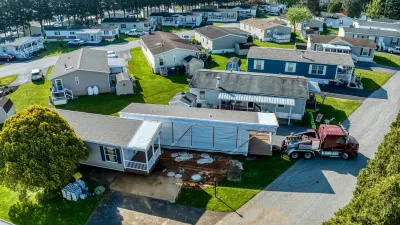
A rule changed proposed as part of the Road to Housing Act passed by a Senate committee in July could make it much easier and cheaper to build manufactured housing, according to an analysis from Pew by Dennis Su and Rachel Siegel.
The change would end the requirement that manufactured homes stay on a chassis to allow them to be relocated. In fact, only 5 to 7 percent of ‘mobile’ homes are ever moved, yet keeping the chassis can increase the cost of a home by around $10,000. “Housing experts say that allowing the chassis to be removed after installation would also allow greater design flexibility. Manufactured homes could be placed in more communities—not only in rural areas but also in empty lots in cities—while waste and cost could be reduced.” The change could make it easier to build multilevel units or add basements, and to place the man level closer to the ground.
The authors note that “While allowing chassis removal after transportation would expand use cases and options, this alone would not be enough. Additional policy updates, such as modernizing zoning and ownership laws to expand access to mortgage financing, would still be needed so this option can reach its full potential to help address the deep national housing supply shortage.”
FULL STORY: Proposal Could Lower Manufactured Home Costs, Expand Housing Supply

HUD Reforms to Manufactured Housing Policy Could Unlock More Affordable Homes
The agency took a series of steps to make manufactured homes, often excluded from neighborhoods and loan programs, more accessible and affordable.

Manufactured Crisis: Losing the Nation’s Largest Source of Unsubsidized Affordable Housing
Manufactured housing communities have long been an affordable housing option for millions of people living in the U.S., but that affordability is disappearing rapidly. How did we get here?

States Move to Protect Mobile Home Park Residents
Making it easier for mobile home park residents to collectively purchase the land they live on can protect their housing affordability for the long term.

Planetizen Federal Action Tracker
A weekly monitor of how Trump’s orders and actions are impacting planners and planning in America.

The state-sanctioned urbicide of Austin
People don’t kill cities. Freeways do.

US to reduce Colorado River water deliveries to Mexico
A new Colorado Treaty amendment reduces Mexico’s Colorado River water allocation by 250,000 acre feet.

5 New England states march closer to 800 megawatt wind energy project
Securing federal approval for the project may be complicated under the Trump administration, which has historically been hostile towards domestic wind power.

Baltimore to break ground on $50 million Transit Priority Project
The project will bring faster bus trips, safer streets and better bike connections to Baltimore.

Airbnb launches $250 million 'last-dollar financing' housing accelerator, makes first investment in Austin
The company will put $6.4 million towards affordable housing development in Texas’ capital.

FREE Course: Walkable City 1: Why Walkability?
After describing his path towards focusing on walkability as the essence of good planning, Jeff Speck marches through his five principal reasons for making more walkable places.
Reinventing Malls: Planning Alchemy—Turning Gray Fields Into Gold
The course focuses on the opportunities and imperatives that shape reinvention of mall sites.

Eagle County Government
Harvard University Graduate School of Design
Nashville Planning Department
The Architects Foundation
University of Cincinnati Online
The Pocatello Development Authority
The Urban Renewal Agency of the City of Pocatello
Journal of the American Planning Association