An experiment in ‘arcology’ begun in the 1970s offers lessons in passive architecture that works with, rather than against, harsh climates.


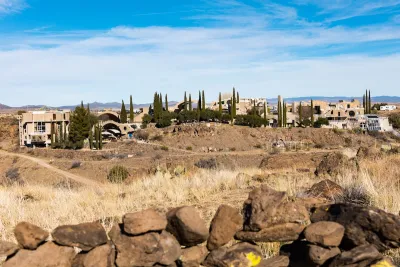
An experimental 1970s Arizona community still offers lessons for sustainable building using passive architecture techniques. Designed by architect Paolo Soleri and located about 70 miles north of Phoenix, Arcosanti is the only example of Soleri’s “arcology” — architecture and ecology — an approach that uses climate-specific designs to build in areas like the desert with extreme weather.
According to a Bloomberg CityLab by Leilani Marie Labong, “Planned for 5,000 residents, Arcosanti currently houses just 38. Residents tend gardens, produce ceramics and craft bronze bells — a core revenue source. They maintain existing structures and, very incrementally, build new ones.” The community struggles with funding and relies on a rotating cast of volunteers, but continues to maintain the 20-acre property.
Around the world, similar developments have had varying degrees of success. Close to home in Arizona, a new development called Culdesac Tempe now houses 300 people in a car-free neighborhood. According to Labong, “Culdesac Tempe looks less like a frontier outpost and more like an amenity-rich urban development, showing that arcology doesn’t have to be fringe.”
Ultimately, Arcosanti remains an unrealized dream, but also a “living, breathing experiment in coexistence.” According to Arcosanti resident and archivist Ray Paskus, the community is “not a monument; it’s a laboratory.”
Read the full story: What a 1970s Commune in Arizona Got Right About Desert Urbanism


Planetizen Federal Action Tracker
A weekly monitor of how Trump’s orders and actions are impacting planners and planning in America.

The state-sanctioned urbicide of Austin
People don’t kill cities. Freeways do.

US to reduce Colorado River water deliveries to Mexico
A new Colorado Treaty amendment reduces Mexico’s Colorado River water allocation by 250,000 acre feet.

Nation's most wind-powered state turns to coal as data centers increase energy demand
For the first time in decades, Iowa has increased its generation of coal power.

NYC cools commuters with city's first rain garden above a bus stop
New York City officials say the plants in the rain garden can absorb 16 gallons of rainwater during heavy storms.

Brightline West’s future may rely on $6 billion federal loan
The company has until Nov. 2 to make a $400 million equity investment into its proposed high-speed rail line.

FREE Course: Walkable City 1: Why Walkability?
After describing his path towards focusing on walkability as the essence of good planning, Jeff Speck marches through his five principal reasons for making more walkable places.
Reinventing Malls: Planning Alchemy—Turning Gray Fields Into Gold
The course focuses on the opportunities and imperatives that shape reinvention of mall sites.

Eagle County Government
Harvard University Graduate School of Design
Nashville Planning Department
The Architects Foundation
University of Cincinnati Online
The Pocatello Development Authority
The Urban Renewal Agency of the City of Pocatello
Journal of the American Planning Association