A new book asks, what if cities were designed around health equity?


“What if buildings and neighborhoods were planned with health and climate risks in mind, just like businesses use financial data to guide their decisions?” Liz York poses this question in an op-ed for Next Cities, leaning on the findings in Adele Houghton and Carlos Castillo-Salgado’s new book, Architectural Epidemiology.
Just as a doctor might diagnose a patient based on symptoms and environmental exposures, Houghton and Castillo-Salgado’s framework helps designers, developers and policymakers diagnose the health of a place.
The process uses place-based data about health and climate to inform customized development strategies. In the South Bronx, one of New York City’s most environmentally burdened neighborhoods, an affordable housing development “took an indoor-focused strategy” to improve air quality for residents. “With no regulatory leverage to reduce nearby traffic or emissions, the project team instead designed a protective shell: a high-performance building envelope, mechanical exhaust and ventilation systems, low-VOC materials and a no-smoking policy. These features directly addressed local respiratory and cardiovascular risk data, providing a sanctuary of clean air in a polluted context.”
Other, larger projects have the opportunity to be part of a broader health equity initiative. In East London’s Hackney borough, a project called Gillett Square that dates back to the 1980s transformed a former parking lot and surrounding area into a square surrounded by workspaces and retail prioritized for local businesses and cultural groups. “Importantly, these design moves responded to both immediate and long-term public health concerns identified in the Architectural Epidemiology framework: exposure to air pollution, heat vulnerability, mental health stressors and pedestrian safety risks.”
FULL STORY: What If We Designed Cities Like a Doctor?


How Urban Design Impacts Public Health
With more and more people living in cities, designing equitably healthy urban spaces becomes a key question for policymakers.
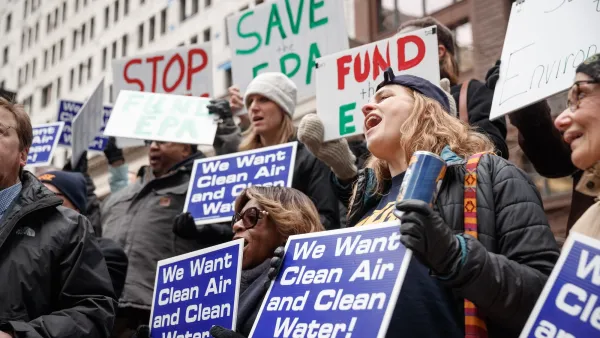
EPA Guts Emissions Regulations
The agency is eliminating the endangerment finding that underpins the agency’s authority to regulate greenhouse gas emissions.

Comment: EPA Cuts will Send Atlanta Back to Eye-burning Ozone, Lung-damaging Smog, and Raw Sewage in the Chattahoochee River
A veteran political journalist takes stock of the hard-earned ground Georgia stands to lose with slashed environmental protection.

The state-sanctioned urbicide of Austin
People don’t kill cities. Freeways do.

US to reduce Colorado River water deliveries to Mexico
A new Colorado Treaty amendment reduces Mexico’s Colorado River water allocation by 250,000 acre feet.

New Jersey’s second-largest city bans standalone data centers
Jersey City will continue to allow co-location facilities, such as those meant for research institutions that store their own data.

Amtrak not solely to blame for New Jersey commuter rail's unreliability, report finds
A new study from the Garden State Initiative found that NJ Transit’s budget grew 20% across a 4 year period, but reliability declined significantly over the same period.

EPA erases limits on planet-warming pollution from power plants
Under Monday’s plan, power plants would still have some limits on how much mercury, arsenic and other contaminants they can emit.

Phoenix announces new on-demand transit service, more frequent RAPID buses
Both new services will launch in October, and are part of Phoenix's Project Effective Access Solutions for Easing Congestion.

FREE Course: Walkable City 1: Why Walkability?
After describing his path towards focusing on walkability as the essence of good planning, Jeff Speck marches through his five principal reasons for making more walkable places.
Reinventing Malls: Planning Alchemy—Turning Gray Fields Into Gold
The course focuses on the opportunities and imperatives that shape reinvention of mall sites.


Eagle County Government
Harvard University Graduate School of Design
Nashville Planning Department
The Architects Foundation
University of Cincinnati Online
The Pocatello Development Authority
The Urban Renewal Agency of the City of Pocatello
Journal of the American Planning Association