Long Beach City College offers a Safe Parking Program to enrolled students who need a safe place to spend the night. Other schools are skeptical.


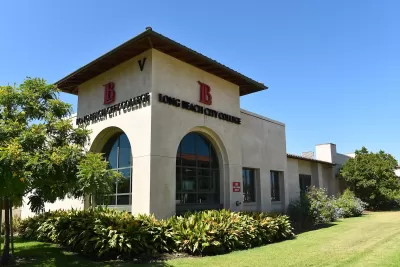
With nearly three out of five of California’s community college students facing housing insecurity, sleeping in their cars on campus becomes the safest option for many. Yet most of the state’s colleges don’t allow the practice, writes Briana Mendez-Padilla in a deep dive for CALmatters, pointing out one school that did launch a Safe Parking Program: Long Beach City College.
“To help these students, multiple legislative measures have tried to create safe parking options similar to Long Beach City College’s,” but legislators killed one proposed bill Assembly Bill 1818, in August. Some community college districts opposed the bill, which would have required the creation of safe parking pilot programs, citing concerns about liability risk and cost.
In Long Beach, students can park in a designated lot next to the campus safety building, where they can access bathrooms and nearby showers. “For the 2022-23 academic year, the program had a total of 24 students. Twelve of them found transitional or permanent housing. For fall 2023, 21 students enrolled in the program, two obtained permanent housing and 19 of them continued into spring 2024.”
Other schools aren’t as welcoming. “On Oct. 25, 2023, Cal Poly Humboldt students received a mass announcement stating that the university would begin enforcing a parking policy it had previously overlooked and would be evicting students who were found sleeping in their vehicles overnight.”
Assemblymember Corey Jackson, who introduced AB 1818, says he will reintroduce it next year.
FULL STORY: Homeless students can sleep safely in their cars at this California college. Other campuses say no

Long Beach City College Lets Unhoused Students Sleep in Parking Lot
Almost half of U.S. college students face housing insecurity, and some schools are stepping up to offer stopgap solutions to the crisis.
California Supreme Court Rules in Favor of People's Park Housing
The decision paves the way for a controversial student housing development.
UC Berkeley Says Supportive Housing ‘Inseparable’ Part of People’s Park Project
The park remains closed to the public as a court weighs a decision on the university’s proposed housing development.

Planetizen Federal Action Tracker
A weekly monitor of how Trump’s orders and actions are impacting planners and planning in America.

The state-sanctioned urbicide of Austin
People don’t kill cities. Freeways do.

US to reduce Colorado River water deliveries to Mexico
A new Colorado Treaty amendment reduces Mexico’s Colorado River water allocation by 250,000 acre feet.

Mamdani overhauls NYC's Vision Zero plan with 100 new policy goals
The overhaul aims to reduce traffic deaths and make streets safer for pedestrians, cyclists and drivers through lower speed limits, new safety infrastructure and more.

Amtrak not solely to blame for New Jersey commuter rail's unreliability, report finds
A new study from the Garden State Initiative found that NJ Transit’s budget grew 20% across a 4 year period, but reliability declined significantly over the same period.

EPA erases limits on planet-warming pollution from power plants
Under Monday’s plan, power plants would still have some limits on how much mercury, arsenic and other contaminants they can emit.

FREE Course: Walkable City 1: Why Walkability?
After describing his path towards focusing on walkability as the essence of good planning, Jeff Speck marches through his five principal reasons for making more walkable places.
Reinventing Malls: Planning Alchemy—Turning Gray Fields Into Gold
The course focuses on the opportunities and imperatives that shape reinvention of mall sites.

Eagle County Government
Harvard University Graduate School of Design
Nashville Planning Department
The Architects Foundation
University of Cincinnati Online
The Pocatello Development Authority
The Urban Renewal Agency of the City of Pocatello
Journal of the American Planning Association