Mobile food vendors can now apply for permits to operate in several of the city’s public spaces.


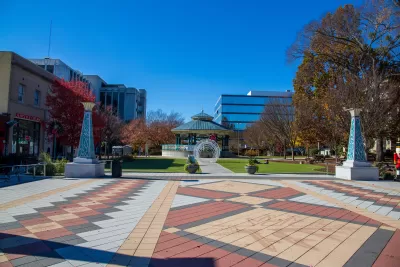
Food carts will be allowed to operate in public spaces in Decatur, Georgia, after the city approved a new mobile food vendor program, reports Beth McKibben in Eater Atlanta.
The program revises a 2019 program that excluded businesses viewed as competing with existing brick-and-mortar operations. “The latest revamp of the mobile food cart program appears to be a course correction for Decatur to be more inclusive and provide a clearer avenue for accountability.” McKibben explains, “Interested businesses must apply for consideration by June 20, carry a current license, and assure carts meet the required dimensions criteria.”
Mobile food vendors in Georgia have to navigate a complex web of state and local regulations. According to the article, as of last year, vendors can operate in multiple counties under one permit, but “Despite updates to the laws and loosening of restrictions, Georgia and Atlanta still remain less hospitable for food trucks and carts to do business than in other states and cities across the country.”
Read the full story: Decatur Okays Food Cart Operations in Public Spaces Across the City, Again


Legalizing Street Vending: Lessons from Los Angeles
With new regulations poised to add 400 new vendors to New York City's streets every year for the next decade, city leaders can look to L.A.'s recent legalization efforts for guidance.
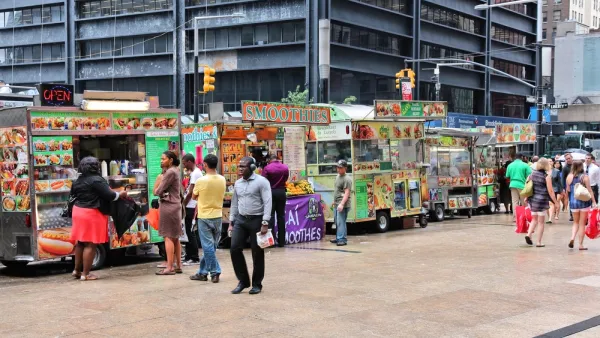
Unleashing the Food Vendors in New York
Newly proposed legislation in the New York State Senate would bar cities from setting limits on the number of food vendors operating in the public realm.
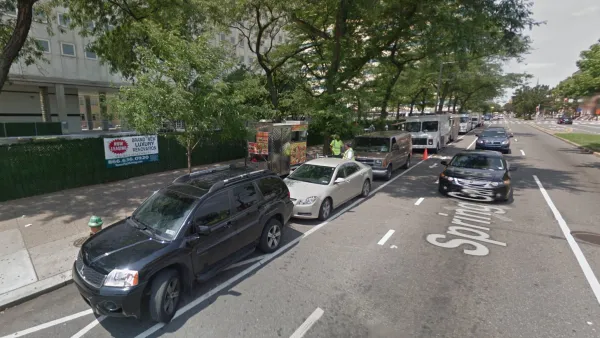
Food Cart Vendors Struggle to Keep a Foothold Around Philly Development
Food cart vendors are fighting for their livelihood in a neighborhood in Philadelphia, against the long legislative reach of a local developer.

Planetizen Federal Action Tracker
A weekly monitor of how Trump’s orders and actions are impacting planners and planning in America.

California plans to bury El Niño’s downpour
If the state plays its cards right, it may be able to store a billion acre-feet of El Niño’s water in aquifers.

Chicago breaks ground on $3 billion megadevelopment
The new neighborhood, titled Foundry Park, will one day host 3,700 residences.

Satanic Place Names
From streams and lakes to valleys and canyons, I mapped more than 1,000 places named after the Devil.

California High-Speed Rail Authority CEO resigns after $600,000 scandal
Under Ian Choudri, the authority used taxpayer dollars to fund first class flights and trips to nightclubs.

Want to study the Missouri River? Soon, you may need unanimous approval from 10 states
Legislation would require 10 governors’ permission to study or build projects moving water outside the basin.

FREE Course: Walkable City 1: Why Walkability?
After describing his path towards focusing on walkability as the essence of good planning, Jeff Speck marches through his five principal reasons for making more walkable places.
Reinventing Malls: Planning Alchemy—Turning Gray Fields Into Gold
The course focuses on the opportunities and imperatives that shape reinvention of mall sites.

City of Rosemead
Rutgers University, Edward J. Bloustein School of Planning and Public Policy
One Hundred Miles
Hunter College, City University of New York (CUNY)
The Architects Foundation
University of Cincinnati Online
City of Cambridge
Montrose County
The Pocatello Development Authority