As sea levels rise, experts say coastal communities have to overcome their resistance to managed retreat and plan for relocation.


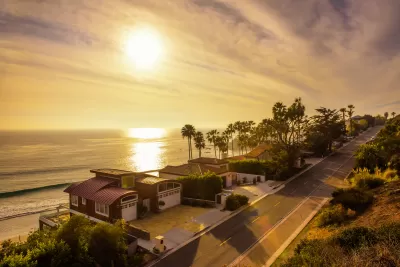
In a Smart Cities Dive brief, Ysabelle Kempe outlines the findings of a report from the Ocean & Climate Platform that warns West Coast communities to prepare for managed retreat, a “long-term transformative option” for mitigating sea level rise that many cities have been reluctant to consider.
The practice of relocating people and infrastructure remains contentious and has led to political conflict, notably over potential tax revenue loss for cities, the report says. It adds that communities are still primarily preventing coastal erosion with physical “armoring” such as seawalls, but there is a growing interest in nature-based solutions such as restoration of oyster reefs and wetlands.
The report “calls for a reframing of the debate around managed retreat” that would “rethink the intersection of built and natural spaces” in a way that is “anticipated, consented to and integrated in phased and flexible manners” for the community. The report names as examples the relocation of several segments of California state highway that secured the roadway and enabled shoreline restoration.
The report urges communities to begin planning as soon as possible to avoid higher costs in the future, but acknowledges that much of California coastal real estate “simply remains too financialized, and properties retain too much economic value” to easily relocate.
Read the full story: As sea levels rise, it’s time for West Coast communities to overcome ‘taboo of managed retreat’: report


California State Law Calls on Coastal Regions to Create Resiliency Plans
Cities and counties at risk of flooding and erosion from sea level rise can access state funding to implement coastal resiliency plans.
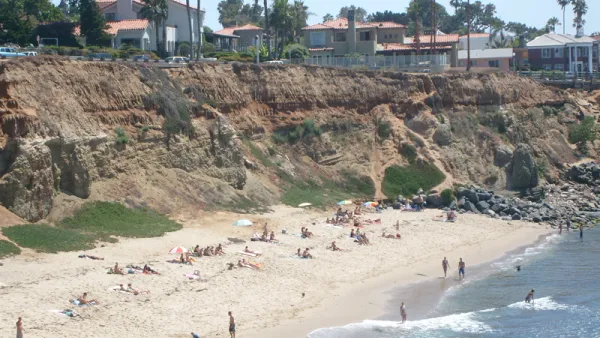
Coastal City Rejects 'Managed Retreat' Strategy
Del Mar, in Southern California, says it does not want to adopt the approach as part of its sea-level rise adaptation plan.
Study Compares Natural and Hybrid Infrastructure Options for Coastal Protection
As coastal communities look for new ways to build resilience, they'll need to consider options such as the natural and hybrid systems compared in a new study by the National Oceanic and Atmospheric Administration.

Planetizen Federal Action Tracker
A weekly monitor of how Trump’s orders and actions are impacting planners and planning in America.

The state-sanctioned urbicide of Austin
People don’t kill cities. Freeways do.

US to reduce Colorado River water deliveries to Mexico
A new Colorado Treaty amendment reduces Mexico’s Colorado River water allocation by 250,000 acre feet.

Nation's most wind-powered state turns to coal as data centers increase energy demand
For the first time in decades, Iowa has increased its generation of coal power.

NYC cools commuters with city's first rain garden above a bus stop
New York City officials say the plants in the rain garden can absorb 16 gallons of rainwater during heavy storms.

Brightline West’s future may rely on $6 billion federal loan
The company has until Nov. 2 to make a $400 million equity investment into its proposed high-speed rail line.

FREE Course: Walkable City 1: Why Walkability?
After describing his path towards focusing on walkability as the essence of good planning, Jeff Speck marches through his five principal reasons for making more walkable places.
Reinventing Malls: Planning Alchemy—Turning Gray Fields Into Gold
The course focuses on the opportunities and imperatives that shape reinvention of mall sites.

Greater Baltimore Committee
Eagle County Government
Harvard University Graduate School of Design
The Architects Foundation
University of Cincinnati Online
The Pocatello Development Authority
The Urban Renewal Agency of the City of Pocatello
Journal of the American Planning Association