Developers, environmentalists, and other experts discussed the challenge of achieving all-electric homes and businesses at VerdeXchange 2019.



At the VerdeXchange 2019 Conference, leaders in real estate, infrastructure, and environmentalism charted a path to reducing carbon emissions from the built environment.
A real-estate perspective was provided by Sara Neff, senior vice president of sustainability at Kilroy Realty Corporation.
"The conversation around all-electric buildings may have been going on for a very long time in the environmental community, but it has only recently come to real estate," Neff said, noting that sustainability commitments from major firms have typically revolved around efficiency. "All-electric buildings seem like a new and crazy thing to us."
Obstacles to more sustainable buildings include flaws in the LEED model that can actually discourage electrification, she said, and the difficulty of tracking the carbon impacts embodied in building materials.
The panel was led by Panama Bartholomy, director of the Building Decarbonization Coalition, which recently released a report advocating zero-emission building codes to help California transition to all-electric buildings.
"In 2018, building decarbonization really hit the public consciousness," Bartholomy told the audience, citing a $200 million program from the California Public Utilities Commission. "In 2019, we’re going to see implementation … We have a big year ahead of us."
Also featured were Russell Fortmeyer of Arup, the global planning and design firm, and Jeff Addison of Subterra Renewables, which equips buildings with geothermal power. Context for the environmental impact of natural gas was provided by Tim O'Connor of the Environmental Defense Fund. Read an edited transcript in The Planning Report or watch the video at Verdexchange.org.
FULL STORY: Decarbonizing the Built Environment: California's Relentless Push Toward Electrification

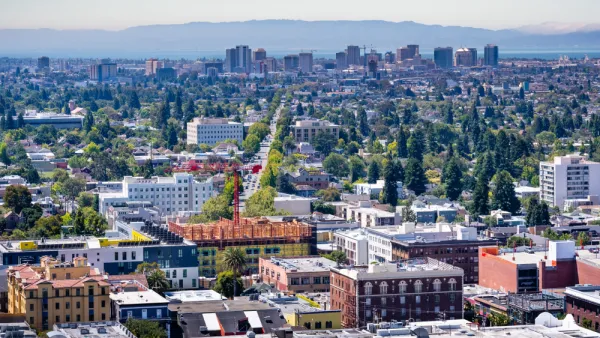
Another Berkeley 'First': Banning Natural Gas Lines in New Buildings
On Tuesday night, the City Council of Berkeley, Calif., unanimously voted to ban natural gas infrastructure from new buildings starting next year, the first city in the U.S. to pass such an ordinance. Fifty cities in the state could be next.
Taking the Carbon Emissions Out of Buildings
Much of the focus on decreasing carbon emissions is on the electrical grid and vehicles. But, buildings are a huge contributor, and California is leading the way in making electrification a priority.

Improving Indoor Air Quality, One Block at a Time
A movement to switch to electric appliances at the neighborhood scale is taking off in California.

The state-sanctioned urbicide of Austin
People don’t kill cities. Freeways do.

US to reduce Colorado River water deliveries to Mexico
A new Colorado Treaty amendment reduces Mexico’s Colorado River water allocation by 250,000 acre feet.

New Jersey’s second-largest city bans standalone data centers
Jersey City will continue to allow co-location facilities, such as those meant for research institutions that store their own data.

Amtrak not solely to blame for New Jersey commuter rail's unreliability, report finds
A new study from the Garden State Initiative found that NJ Transit’s budget grew 20% across a 4 year period, but reliability declined significantly over the same period.

EPA erases limits on planet-warming pollution from power plants
Under Monday’s plan, power plants would still have some limits on how much mercury, arsenic and other contaminants they can emit.

Phoenix announces new on-demand transit service, more frequent RAPID buses
Both new services will launch in October, and are part of Phoenix's Project Effective Access Solutions for Easing Congestion.

FREE Course: Walkable City 1: Why Walkability?
After describing his path towards focusing on walkability as the essence of good planning, Jeff Speck marches through his five principal reasons for making more walkable places.
Reinventing Malls: Planning Alchemy—Turning Gray Fields Into Gold
The course focuses on the opportunities and imperatives that shape reinvention of mall sites.

Eagle County Government
Harvard University Graduate School of Design
Nashville Planning Department
The Architects Foundation
University of Cincinnati Online
The Pocatello Development Authority
The Urban Renewal Agency of the City of Pocatello
Journal of the American Planning Association