The new Walkable City Rules by Jeff Speck is an excellent book that can help your city become more hospitable to humans. Urban thinker Kaid Benfield reviews.



"If the purpose of Walkable City was to tell us why we need to make more people-friendly places, Walkable City Rules is intended to tell us how. To a great extent, it succeeds in its mission."
"I absolutely love the format: The book comprises 19 sections or “parts,” each containing some three to seven “rules.” Each section (e.g., “Get the Parking Right”) is introduced briefly, and each of the rules it contains (“Eliminate On-Site Parking Requirements”) is presented in a two-page layout with a headline followed by a narrative explication, an illustration or two, and then a slightly longer and more precise restatement of the rule."
"Unlike its predecessor, Walkable City Rules is full of examples and illustrations, including 120 full-color photos and figures. The volume is excellent for browsing and should make a great reference work."
Benfield goes on with a meaty review of Speck's book, along with a strong recommendation of its worth, particularly on the subjects of attainable housing and transit. He calls it "a manifesto for reforming urban transportation policy and infrastructure and ... reducing the negative impacts of automobiles on walkability and on our cities."
Read the full story: Jeff Speck’s Step-by-Step Guide to Making Better Urban Places


Planetizen Federal Action Tracker
A weekly monitor of how Trump’s orders and actions are impacting planners and planning in America.

The state-sanctioned urbicide of Austin
People don’t kill cities. Freeways do.
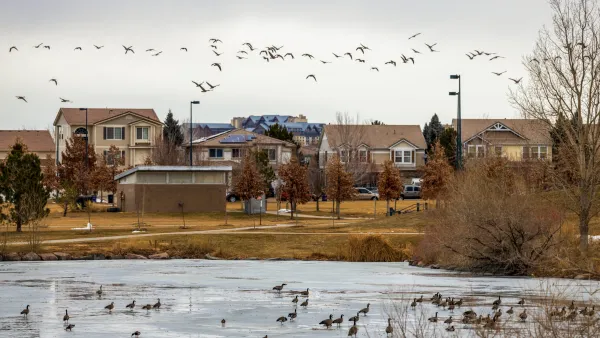
Colorado’s Largest Data Center Could Rise Next to Homes — Without a Public Hearing
The proposed campus would consume 11 times the power of Denver International Airport; as it has across the country, opposition mounts.

Nation's most wind-powered state turns to coal as data centers increase energy demand
For the first time in decades, Iowa has increased its generation of coal power.

NYC cools commuters with city's first rain garden above a bus stop
New York City officials say the plants in the rain garden can absorb 16 gallons of rainwater during heavy storms.

Brightline West’s future may rely on $6 billion federal loan
The company has until Nov. 2 to make a $400 million equity investment into its proposed high-speed rail line.

FREE Course: Walkable City 1: Why Walkability?
After describing his path towards focusing on walkability as the essence of good planning, Jeff Speck marches through his five principal reasons for making more walkable places.
Reinventing Malls: Planning Alchemy—Turning Gray Fields Into Gold
The course focuses on the opportunities and imperatives that shape reinvention of mall sites.

Greater Baltimore Committee
Eagle County Government
Harvard University Graduate School of Design
The Architects Foundation
University of Cincinnati Online
The Pocatello Development Authority
The Urban Renewal Agency of the City of Pocatello
Journal of the American Planning Association