The safe parking lot is part of Project Connect, a district-led initiative that provides services to students and families.


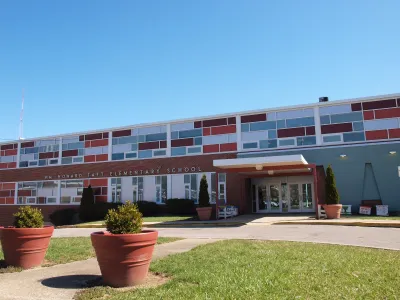
A service project from Cincinnati Public Schools will start offering district families experiencing homelessness a safe place to sleep in their cars starting April 30, reports Robin Gee in CityBeat.
The Safe Sleep initiative will allow students and families to spend the night in a lot at Taft Elementary School. Rebeka Beach, program manager for Project Connect, said " want to say we don’t look at this necessarily as a solution. But the fact is we do have families who are sleeping in their vehicles, and we want to provide them with dignity and respect. We also want to provide them with safety."
Over 8,000 Cincinnati children experience homelessness every year, according to nonprofit Upspring. The city has the second worst child poverty rate of the nation's largest cities, at 53.1%. Project Connect, created in 1996, provides services and resources for unhoused students and their families including a food pantry, school supplies and other household items, and connections with job training and legal services. "Safe Sleep is the latest addition to the Project Connect program, and it directly addresses the immediate needs of families sleeping in cars."
Read the full story: CPS parking lot for families sleeping in cars set to open this month


Seattle Safe Parking Site to Close, Relocate
A nonprofit leases lots during permitting stages to erect tiny homes and RV safe parking sites for unhoused residents. But the model means constant uncertainty and displacement.

Safe Parking Programs Help People Access Housing
The safety and stability offered by Safe Parking sites have helped 40 percent of unhoused San Diego residents who accessed these programs get into permanent housing.

LA has no plan — or funding — to help unhoused people displaced by Olympics security efforts
City and county officials say they don't have the funds to offer housing to the up to 1,600 people that will be displaced by perimeters around event venues.

Planetizen Federal Action Tracker
A weekly monitor of how Trump’s orders and actions are impacting planners and planning in America.

California plans to bury El Niño’s downpour
If the state plays its cards right, it may be able to store a billion acre-feet of El Niño’s water in aquifers.

Chicago breaks ground on $3 billion megadevelopment
The new neighborhood, titled Foundry Park, will one day host 3,700 residences.

California High-Speed Rail Authority CEO resigns after $600,000 scandal
Under Ian Choudri, the authority used taxpayer dollars to fund first class flights and trips to nightclubs.

Want to study the Missouri River? Soon, you may need unanimous approval from 10 states
Legislation would require 10 governors’ permission to study or build projects moving water outside the basin.

Desperate measures: Advocates weigh draining Lake Powell to fill Colorado River
Draining the reservoir could reduce evaporation losses by a couple hundred thousand acre-feet.

FREE Course: Walkable City 1: Why Walkability?
After describing his path towards focusing on walkability as the essence of good planning, Jeff Speck marches through his five principal reasons for making more walkable places.
Reinventing Malls: Planning Alchemy—Turning Gray Fields Into Gold
The course focuses on the opportunities and imperatives that shape reinvention of mall sites.


City of Rosemead
Rutgers University, Edward J. Bloustein School of Planning and Public Policy
One Hundred Miles
Hunter College, City University of New York (CUNY)
The Architects Foundation
University of Cincinnati Online
City of Cambridge
Montrose County
The Pocatello Development Authority