The city is changing zoning codes to proote more multifamily housing development.


The Baltimore City Council is pushing forward with zoning reforms aimed at making housing more affordable, but some residents are accusing the council of ignoring threats to long-term residents.
As Hallie Miller and Emily Opilo explain in an article for The Baltimore Banner, “The public’s concerns ranged from the practical — less parking, more people, more trash — to the philosophical — changing the character of the city.”
One significant proposal, supported by the city’s mayor, would allow multifamily housing in all of the city’d residential neighborhoods. “The mayor pointed to East Baltimore’s Johnston Square neighborhood, a city-backed investment initiative that has carefully baked in community feedback.”
Another proposed bill would eliminate parking minimums. However, critics of the proposed legislation say Baltimore, with its many vacant lots, needs different solutions than denser cities more pressed for affordable housing. According to Samia Kirchner, associate professor of architecture and urban design at Morgan State University, policy efforts may have more impact “if they centered on renovating and reoccupying the existing infrastructure, via investment.”
Read the full story: Baltimore City might be entering its YIMBY era


San Diego wants to limit upzoning law to just 16% of transit-adjacent parcels
The city's planning director says some areas are unfit for immediate upzoning due to a lack of resources or hazards such as wildfire risk.
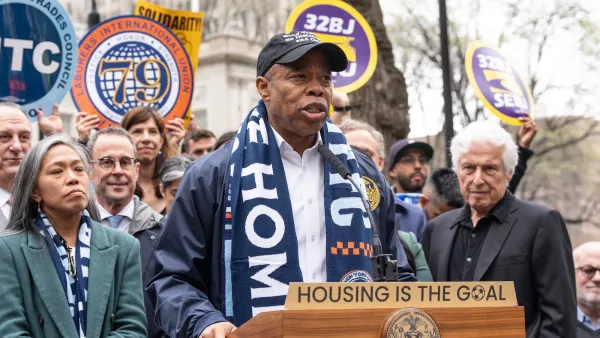
What Actually Got Built Under Eric Adams’ ‘Pro-Housing’ Administration
The outgoing mayor claims credit for hundreds of thousands of new homes. The truth is more complicated.

San Francisco Mayor’s ‘Family Zoning’ Plan Faces Pushback, Displacement Concerns
Newly proposed legislation aims to protect long-term tenants from displacement caused by Mayor Lurie’s proposed zoning reform plan, which would allow for more housing construction in parts of the city.

Planetizen Federal Action Tracker
A weekly monitor of how Trump’s orders and actions are impacting planners and planning in America.

California plans to bury El Niño’s downpour
If the state plays its cards right, it may be able to store a billion acre-feet of El Niño’s water in aquifers.

Chicago breaks ground on $3 billion megadevelopment
The new neighborhood, titled Foundry Park, will one day host 3,700 residences.

California High-Speed Rail Authority CEO resigns after $600,000 scandal
Under Ian Choudri, the authority used taxpayer dollars to fund first class flights and trips to nightclubs.

Want to study the Missouri River? Soon, you may need unanimous approval from 10 states
Legislation would require 10 governors’ permission to study or build projects moving water outside the basin.

Desperate measures: Advocates weigh draining Lake Powell to fill Colorado River
Draining the reservoir could reduce evaporation losses by a couple hundred thousand acre-feet.

FREE Course: Walkable City 1: Why Walkability?
After describing his path towards focusing on walkability as the essence of good planning, Jeff Speck marches through his five principal reasons for making more walkable places.
Reinventing Malls: Planning Alchemy—Turning Gray Fields Into Gold
The course focuses on the opportunities and imperatives that shape reinvention of mall sites.

City of Rosemead
Rutgers University, Edward J. Bloustein School of Planning and Public Policy
One Hundred Miles
Hunter College, City University of New York (CUNY)
The Architects Foundation
University of Cincinnati Online
City of Cambridge
Montrose County
The Pocatello Development Authority