As a debate rages in mainstream media about whether or not America should sprawl, a housing researcher says that's the wrong question. We need to do both.



Not quite three months ago, a piece entitled “Why America Should Sprawl” by reporter Conor Daugherty was prominently featured in the New York Times. While much of it read like a puff piece for a bunch of Texas developers, the medium in which it appeared ensured that it would get attention, arguably more than it deserved on its merits. As a provocation and a challenge to a lot of the conversation on the subject of housing supply, however, it hit the mark. Given the title, there’s little doubt that the provocation was intended; after all, a piece entitled “Why America should carefully extend urban infrastructure to accommodate growth” might work for Planetizen or the Congress for the New Urbanism, but wouldn’t generate much buzz.
A couple of weeks ago, a rejoinder to Daugherty’s piece appeared with the title “Sprawl is Still Not the Answer” by four authors associated with the Rocky Mountain Institute and the World Resources Institute. It didn’t make the Times, but it appeared in Bloomberg City Lab, which is also fairly widely read. Part of the piece is devoted to the environmental case against consuming forests and farmland, which I agree is important to acknowledge. But the guts of the piece are their argument that by reforming local land use regulations we can create almost infinite amounts of housing within the existing built footprint of our central cities. This “we can have our cake and eat it too” proposition is the guts of the environmental argument against greenfield development. Rather than either simply nodding in agreement or dismissing them as cranks, however, it is worth taking a close look at their rationale and their evidence.
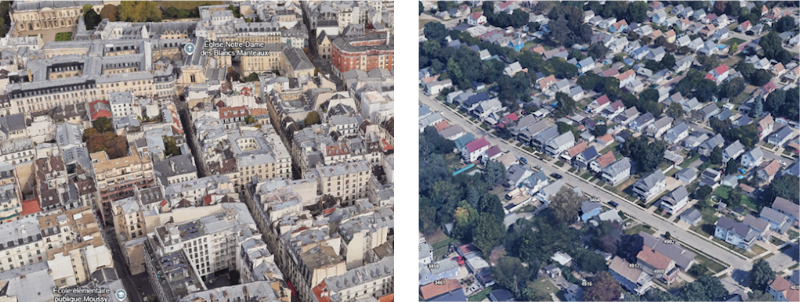
They start with the general and well-known proposition that most American cities have been developed at much lower densities than European cities like Paris or Barcelona, which is certainly true. This relates to their next argument, quoting from a forthcoming analysis that “by modestly increasing housing density — adding just five homes per acre — we could increase housing availability in built-up areas by 15% to 56% across nine states.” Like the density argument, this may well be technically correct. And yes, Haussmann rebuilt Paris in the 19th century with six story apartment buildings covering well over half of each building lot at a time when most American cities were being developed with blocks of single family houses, as we can see in Figure 1.
But both are utterly irrelevant. Urban areas, whatever their density, are not a development tabula rasa. They are intensively developed places which have been subdivided into thousands of separate properties or lots, each one usually occupied by a house or other building, each one of which is usually owned by a different individual, couple or business entity. And it is the feasibility of assembling urban sites, not their underlying density, which dictates whether urban redevelopment happens.
Now, it is true that developers acquire already-developed urban sites and redevelop them at higher density. No city is ever, as some people like to say, “fully developed.” But when looking at urban redevelopment and infill, it is critical to distinguish what actually takes place from what doesn’t. And that is dictated not by what planners and environmentalists would want, but by what makes business sense for developers and property owners. That means finding property owners willing to sell at prices that make redevelopment feasible, and buyers or renters for the end product who are willing and able to pay what it costs the developer to create it and make a fair profit on the outcome.
Development is very expensive, and property owners — particularly homeowners, whose motivations are far from exclusively financial — are unpredictable. The way residential areas in cities like Cleveland have been subdivided means that to acquire even a small buildable parcel — say, two acres — a developer may have to successfully negotiate with twelve or fifteen separate landowners, any one of whom can prevent the project from happening. Which means, among other things, that by the time he or she is finished, acquisition will have becomes a very expensive proposition. Not to mention that the number of people who are willing to pay top dollar rents to live in an apartment building plopped down in a typical Cleveland residential neighborhood are few and far between.
What that means in the real world, is that (1) significant urban redevelopment takes place only in areas of strong demand, which are either hot market cities like San Francisco or Austin or those relatively small parts of cities like Minneapolis or Cleveland where people who both have money and want to live in high-density housing concentrate; and (2) redevelopment almost exclusively takes place in currently commercial or industrial areas in those cities, because that’s where developers find large parcels in single ownership and owners willing to sell. And usually only in those areas that are also close enough to downtown, a major university, or some other amenity to ensure strong demand for the project. That’s what’s happening in Minneapolis, where nearly all the new housing is in large apartment buildings clustered close to downtown and the University of Minnesota.
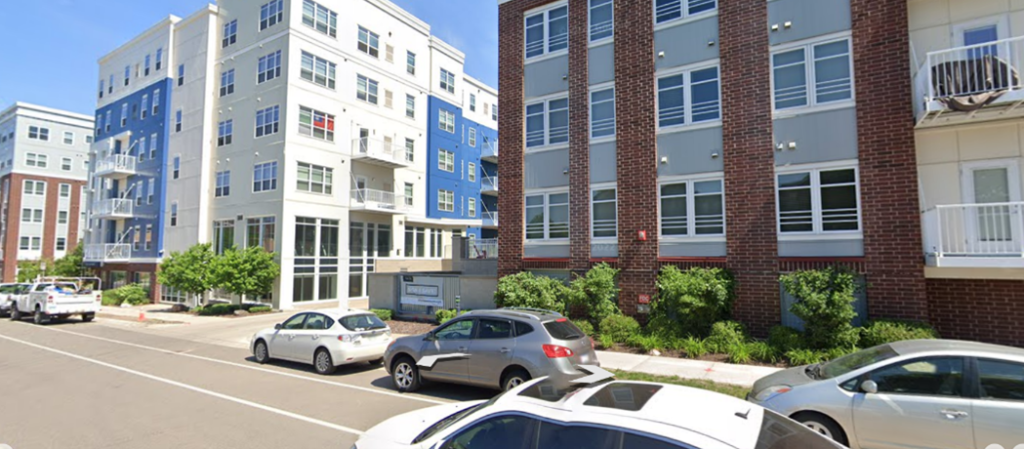
The areas where significant redevelopment does not take place, even after cities rezone those areas, are the vast stretches of our central cities occupied by single family homes, as Minneapolis found after they famously rezoned their single-family neighborhoods. Yes, there are exceptions to this proposition, but they are few and far between. The cost, time and brain damage to would-be developers of assembling enough properties in those areas is rarely proportionate to the potential return. Put differently, it is not scalable.
If we are to be remotely serious about this issue, we need to accept a fundamental proposition to guide our thinking: no strategy to address America’s housing shortage is worth taking seriously unless it is scalable. Piecemeal redevelopment of single family residential areas in cities is not scalable. Up to a point, construction of large multifamily buildings in well-located commercial or industrial areas is scalable in many cities, and, perhaps counter-intuitively, development of accessory dwelling units (ADUs) appears to be scalable — ADUs currently make up 15% to 30% of all new housing units in a number of West Coast cities — but probably only in strong market cities and neighborhoods. Neither, separately or together, will come close to meeting America’s housing needs.
After rather fatuously accusing Daugherty and his ilk of “learned helplessness,” the authors then assert that some American cities are already solving their housing problems, citing Minneapolis and Austin as “the emerging proof.” Minneapolis and Austin are doing well compared to many other American cities, but pointing to them as proof that central cities can solve their housing problems by themselves is like arguing that you can end a nationwide drought by handing out bottles of Perrier. Let’s start with Austin.
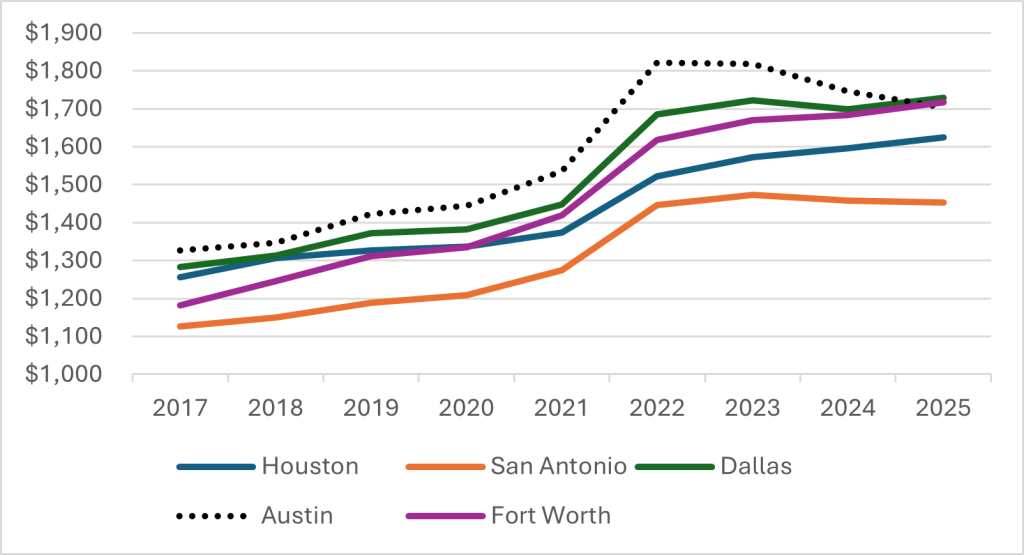
Rents have indeed gone down in the past two years in Austin. But, as figure 3 shows, they are still on the high end among Texas peer cities. The big difference is that Austin’s rents rose faster than in the other cities from 2019 to 2022, which suggests that the decline is more likely a correction, rather than the harbinger of a long-term downward trend. Meanwhile, sales prices in Austin have been going up steadily (+61% from 2017 to 2023), making the city only an average performer among large American cities on that metric.
But what’s even more important to understand about Austin is that the city’s suburbs are building much more housing than the city itself. Between 2015 and 2024, 60% of the building permits issued in the Austin metro were in the suburbs, including 80% of the metro’s single family homes. As every serious student of urban development knows, although perhaps not the authors of “Sprawl is Still Not the Answer,” metros are a single housing market, where what happens in one area affects the others. One of the major reasons why housing is so expensive in New York City is because so little housing is being built in its suburbs, particularly on Long Island and in Westchester County. Whatever is happening to moderate housing costs in Austin is the sum of urban and suburban development, not the result of Austin’s growth alone.
The pattern is similar in Minneapolis. Minneapolis has built a decent amount of housing over the past decade — although no more than many other cities — and both rental and sales price growth has been moderate by national standards. But here, even more than in Austin, all of the growth has been in multifamily housing — and nearly all in large apartment projects, not (as the authors of "Sprawl is Still Not the Answer" claim) small buildings. That's significant, because the large apartment buildings being built in Minneapolis and elsewhere tend to appeal to a very narrow demographic, young college-graduate singles and couples. Furthermore, after a dramatic spurt in permits a few years ago, housing production in Minneapolis has all but collapsed since peaking in 2019. Austin’s pattern has been similar, but less dramatic (figure 4). This may reflect exhaustion of easily-developed sites, or it may reflect overbuilding of a particular type of housing for which demand may be limited, particularly as remote and hybrid work become more customary in many economic sectors. In a market economy like the United States, flat or declining rents may actually be a double-edged sword, since, in conjunction with rising development costs, they can result in reducing profitability and discouraging developers from starting new projects.
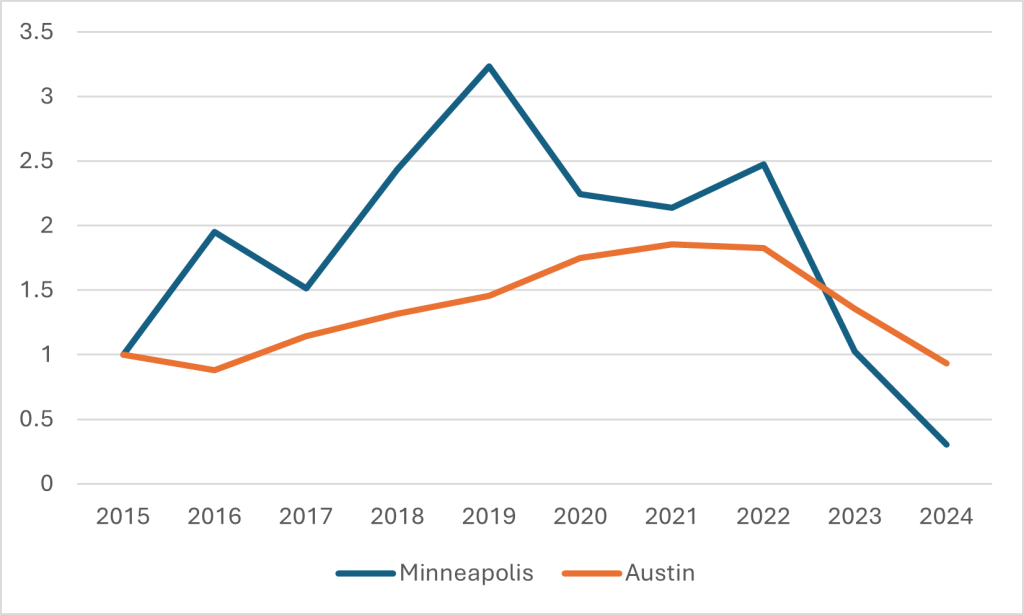
NOTE: Since the numbers are so different in the two cities, a graph showing absolute numbers would be unreadable. Instead, I show permits for each year as a ratio of the number of permits issued in 2015.
More significantly, the reality and importance of simultaneous urban and suburban growth is as true for Minneapolis as it is for Austin. Some 59% of the building permits issued in Hennepin County from 2015 to 2024 were in the suburbs, including 94% of the permits issued for single family homes. [1]
This brings out another important reality of urban densification: nearly all the people who move into the new apartment buildings in the cities, are in 1 or 2 person households. For example, 80% of all added households in Minneapolis between 2013 and 2023, and 85% in Austin, have been 1 or 2 person households. By contrast, almost 2/3 of the growth in Richardson, Texas, a fast-growing suburb of Dallas, over the same period was in households with three or more members. Those families are not looking to live in small apartments in five story buildings.
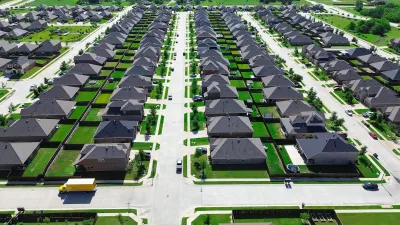
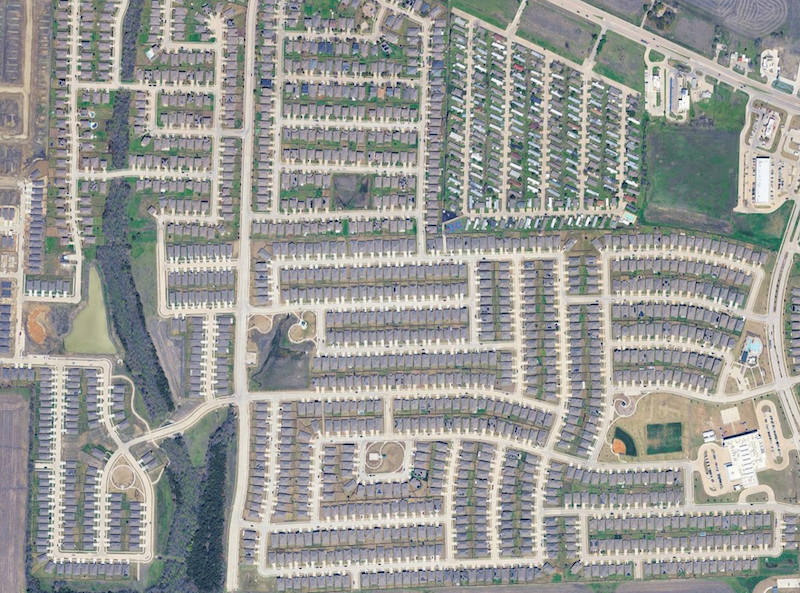
The suburban growth in the Sunbelt may be “sprawl,” if one is going to use that term to describe any and all greenfields development, but as Figure 5 from Princeton, Texas (a city featured in Daugherty’s article) shows, it is very compact sprawl. The homes shown in the image are built at a gross density including streets, playgrounds and such, of roughly five units per acre, and a net density within each block, based on 6250 square foot lots, of seven units per acre. Not quite urban multifamily densities, to be sure, but if one accepts the proposition that there is a continued demand for single family homes, a highly efficient use of land.
In the final analysis, it is not a question of whether to build in the cities or in the suburbs, but to do both. While Daugherty gives a nod to building in cities, he points out that “Even if all the regulatory restraints were removed tomorrow, developers couldn’t find enough land to satisfy America’s housing needs inside established areas.” That’s true, because the constraint isn’t the number of square miles inside a given city, but the feasibility of assembling and redeveloping the land, and the ability to not only build the number of homes people need, but the diversity of home types they want. It is ironic — as the numbers for Austin and Minneapolis show — that a future in which housing needs are met entirely in central cities would replace the much-deplored tyranny of the single family home with a new tyranny of apartment living.[2] But that doesn't mean we shouldn't build what we can inside central cities, including redevelopment and infill housing.
A strategy of both/and should not, and need not, be a mindless one. As I and others have pointed out, the suburbs of America’s cities offer greater opportunities for densification than the cities themselves. Larger suburban lots offer ample scope for ADUs, while miles of vacant or underutilized commercial land along arterial roads, shopping malls and office parks offer room for large-scale development of multifamily housing. Thoughtful planning and environmental management can preserve stream corridors, wetlands, forests and high productivity farmland, while ensuring that the necessary infrastructure and amenities are in place for future development.
A facile “sprawl bad, urban infill good” mantra is no more meaningful than saying “we need more sprawl.” We do need to fill in, but we also need to grow out. What we really need are more productive conversations about how to do both well, rather than more pointless examples of people talking past one another.
[1] To compare metro totals to city totals in the case of Minneapolis would be misleading, because the Minneapolis-St. Paul metro is multipolar, compared to the unipolar Austin metro. In all likelihood, though, the suburban share of metro development as a whole is probably even larger than this data suggests.
[2] For a variety of reasons, which are beyond the scope of this piece but which I hope to touch on in a future piece, we are unlikely to see much so-called “missing middle” housing actually built.


Planetizen Federal Action Tracker
A weekly monitor of how Trump’s orders and actions are impacting planners and planning in America.

Data reveals that NYC’s bet on congestion pricing has paid off
After almost two years of the program, reports show positive impacts on traffic and air quality and no disruptions to parking.

HUD modernizes 50-year-old manufactured housing framework
The Next Generation Manufactured Housing Action Plan establishes new energy-efficiency standards for manufactured homes, and new guidelines for anchoring them.

California voters weigh $11.25 billion housing bond
Prop. 1, combined with other funding, would support over 40,000 new rental units in California.

Connecticut is turning landfills into green infrastructure
Twenty-nine solar arrays have been built, or approved to be built, on top of Connecticut landfills.

Trump guts ‘win-win’ solar energy program for rural farmers
The U.S. Department of Agriculture’s changes have made virtually all solar power ineligible for funding through the Rural Energy for America Program.

FREE Course: Walkable City 1: Why Walkability?
After describing his path towards focusing on walkability as the essence of good planning, Jeff Speck marches through his five principal reasons for making more walkable places.
Reinventing Malls: Planning Alchemy—Turning Gray Fields Into Gold
The course focuses on the opportunities and imperatives that shape reinvention of mall sites.

One Hundred Miles
County of Mendocino
planning NEXT
The Architects Foundation
University of Cincinnati Online
Montrose County
Northern Illinois Transit Authority (NITA)
The Pocatello Development Authority

