Alon Levy argues that the best path to traffic safety is through design rather than traffic law enforcement.



Alon Levy argues that if America is serious about cutting traffic fatalities it will focus on road design. That means "narrower lanes, wider sidewalks, trees, and dedicated bus and bike lanes in order to reduce the number of car lanes as well as provide more room for alternatives. Zoning laws that mandate front setbacks should be repealed, and ideally so should commercial height limits on arterials. In central cities, some road segments should be closed off to cars, if the intensity of urban activities can fill the space with pedestrians."
Levy also argues that we need to reduce the speed of cars in towns "while speed limit reductions offer useful safety benefits, it is important to design the roads to be slower, and not just tell drivers to go slower. Road monotony is especially common in the United States." He goes further suggests that it would be better to enforce these speed laws with cameras, to avoid the bias that humans exhibit in policing.
Read the full story: Safer Streets: Design is Better Than Enforcement
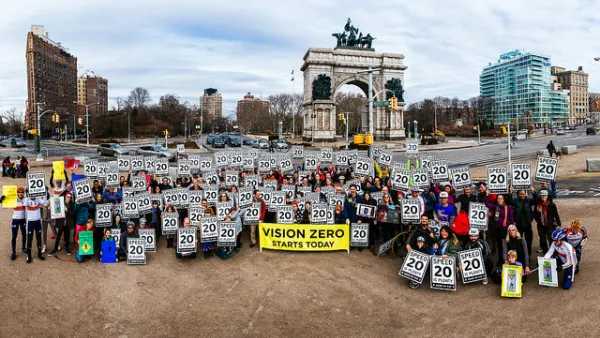
Zero Traffic Deaths Isn't as Far Fetched as It Sounds
Even supporters of Vision Zero—a goal to eliminate traffic fatalities from roadways adopted by cities and states all over the United States—doubt that such lofty ambitions are possible. But there are plenty of reasons to believe in the cause.
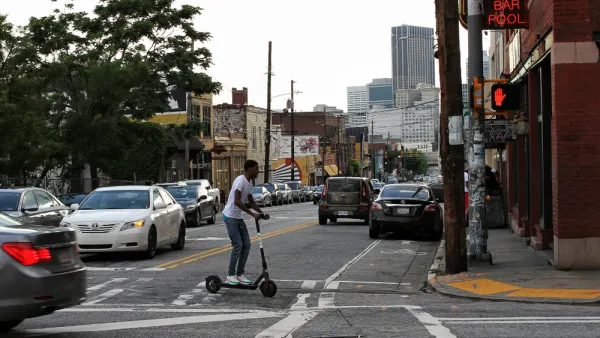
Atlanta Lowers Speed Limits Citywide
Vision Zero arrives in one of the country's most car-centric big cities.

U.S. Lagging in Making Streets Safer for Pedestrians
Pedestrian deaths are on the rise in the United States, but cities have been slow to implement effective policies and road design measures to change the trend.

Planetizen Federal Action Tracker
A weekly monitor of how Trump’s orders and actions are impacting planners and planning in America.

Washington state to charge fee to drivers with fuel-efficient cars
Revenue from the fee will go towards supporting the state’s highways.

Illinois considers spending $1 billion in taxpayer money on data center
A quantum computing campus and data center are currently under construction in Chicago.

People Mover delayed again, LAX and contractor trade barbs
The automated train was last slated to open in January 2027.

Trump to blast ‘hydrocarbon highway’ through ‘world’s longest art gallery’
Environmental and historic preservation groups are suing to stop the project.

25 states cast bids to be the home of U.S. Space Academy
The academy will train scientists, officers and astronauts for the U.S. Space Force.

FREE Course: Walkable City 1: Why Walkability?
After describing his path towards focusing on walkability as the essence of good planning, Jeff Speck marches through his five principal reasons for making more walkable places.
Reinventing Malls: Planning Alchemy—Turning Gray Fields Into Gold
The course focuses on the opportunities and imperatives that shape reinvention of mall sites.

City of Charlotte
City of Rosemead
Rutgers University, Edward J. Bloustein School of Planning and Public Policy
University of Michigan School for Environment and Sustainability (SEAS)
Hunter College, City University of New York (CUNY)
The Architects Foundation
University District Partnership