According to Seymour Toll's 1969 book, New York City's 1916 zoning code was less a civic-minded project than an attempt to protect elite retail districts from the riff-raff. The ramifications for American zoning at large are significant.


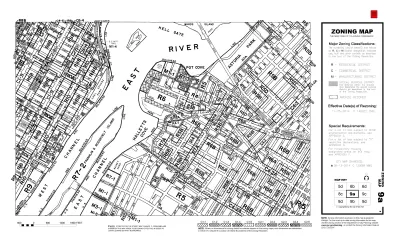
For a short time during the late 1960s, Jake Blumgart writes, "zoning received the attention it deserved as a monumental force shaping the character of many American communities—in large part due to civil rights protests over its exclusionary effects in newer suburbs." Today, renewed debate about urban segregation has cast zoning into the spotlight once again.
In his 1969 book Zoned American, Seymour Toll gives us "an in-depth history of the 1916 New York code, the progenitor of zoning codes nationwide, and the impetus for its creation. The received history of zoning often frames it as a creation of Progressive-era good government planners. But Zoned American shows that the code was actually created as a weapon to defend the narrow self-interest of a small group of prestigious merchants."
In a move that presages problematic zoning later in the century, "wealthy retailers based along Fifth Avenue were the advance guard of zoning in New York. Dubbed the Fifth Avenue Association, they believed their investments would be compromised by the northward advance of the garment industry and the hordes of foreign born workers that accompanied it."
The zoning that emerged from these conditions had specific and recognizable prejudices. It sought to constrain density and height, separating uses to preserve "the northern stretch of Fifth Avenue—and Manhattan more generally—for businesses that catered to the wealthy."
Stephen Smith, well-known as the voice behind @MarketUrbanism on Twitter, remarked, '"There wasn't some grand plan, zoning was taking whatever was there and freezing it [...] Toll convinced me it wasn't really planning, it was just reacting to whatever was already built.'"
Read the full story: Learning from 'Zoned American'


Critics: NYC Zoning Promotes Segregation, Inequality
The editors of a new book on displacement in New York argue that the city's historical record of exclusionary zoning carries over into the present. Urbanist concepts in vogue today simply rehash old divides.
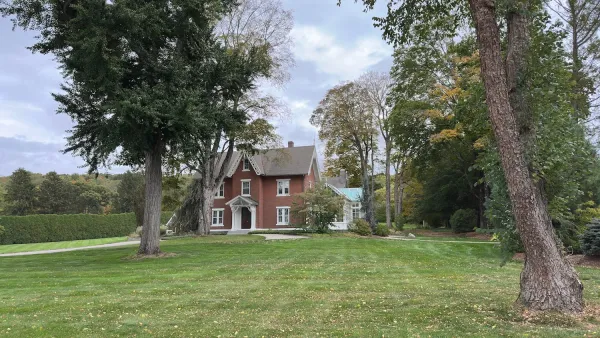
Study: Minimum lot sizes reinforce racial disparities
A Connecticut study found that zoning rules perpetuate residential segregation.
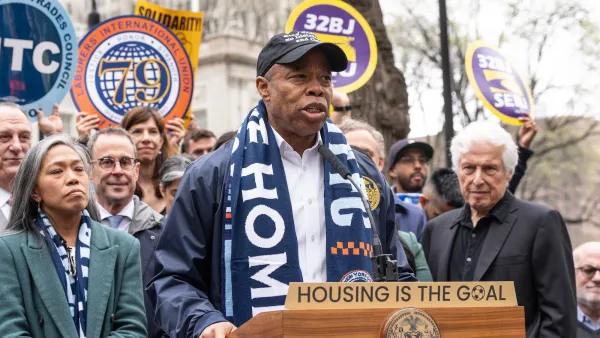
What Actually Got Built Under Eric Adams’ ‘Pro-Housing’ Administration
The outgoing mayor claims credit for hundreds of thousands of new homes. The truth is more complicated.

Planetizen Federal Action Tracker
A weekly monitor of how Trump’s orders and actions are impacting planners and planning in America.

‘Going backwards:’ Baltimore mayor, students rally against state's transit funding plan
Maryland's proposed six-year plan provides no funding for Baltimore’s BMORE bus program and reduces its road maintenance funding.

Detroit to transform waterfront with $2.2 billion investment
Developers will convert about 18 acres of unused parking lot space into civic spaces.

Newsom vetoes high-speed rail supervision bill after agency receives condemnatory audit
The audit found the CHSRA approved almost $600,000 in unallowable travel expenses.

Nation sees first electric plane-boat hybrid take off in public demo
The Viceroy Seaglider can fly at speeds of 180mph for up to 180 miles.

One of nation’s poorest counties to receive $6 billion data center
The developers estimate the project will create 200 permanent jobs and 1,000 temporary construction jobs.

FREE Course: Walkable City 1: Why Walkability?
After describing his path towards focusing on walkability as the essence of good planning, Jeff Speck marches through his five principal reasons for making more walkable places.
Reinventing Malls: Planning Alchemy—Turning Gray Fields Into Gold
The course focuses on the opportunities and imperatives that shape reinvention of mall sites.

City of Thousand Oaks
City of Wisconsin Rapids
Harvard University Graduate School of Design
The Architects Foundation
University of Cincinnati Online
Northern Illinois Transit Authority (NITA)
The Pocatello Development Authority
The Urban Renewal Agency of the City of Pocatello