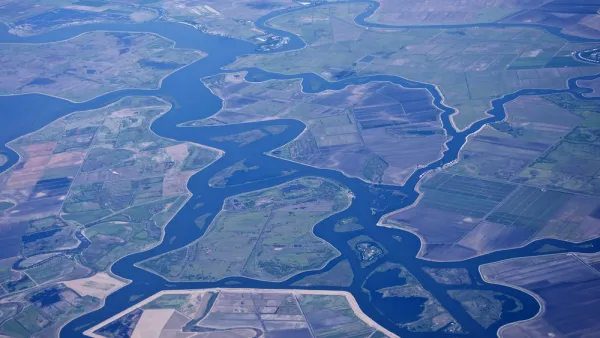
The planning process has revealed more modest potential benefits for the highly controversial proposal to spend $15 billion on tunnels to ease environmental strain on the Bay Delta.


Bettina Boxhall reports on the evolution of one of the state of California's most controversial infrastructure projects: a $15-billion diversion and tunnel system in the Bay Delta.
The article reveals an under-reported shift has occurred during the planning process for the tunnel project. According to Boxhall, "as the project has gone through a protracted environmental review by skeptical federal fishery agencies, reality has set in. Instead of cranking open the pumps, the tunnels will, at best, do little more than maintain the status quo."
Boxhall then goes on to detail the benefits of the project, as currently proposed, while referencing the authority of the California Department of Water Resources and U.S. Bureau of Reclamation on the project.
Among the tempered potential of the project, as currently proposed:
- "The tunnels would lessen the damaging reverse flows. But they would not cure the delta's other ecological ailments…"
- The project would not "escape the regulations concerning endangered species and water quality that will probably grow tougher in response to the delta's cascading environmental woes."
- "If the tunnels are built, state modeling indicates future delta exports to the valley's thirsty fields and Southern California's faucets would average 4.9 million acre-feet a year — only a small improvement over recent averages."
The article provides lengthy, in-depth coverage of the project's history, the Delta's ongoing ecological crisis, the state of California's ongoing drought, and the politics surrounding the tunnel project.
FULL STORY: A delta tunnel project's lofty ambitions have been scaled back

Feds to Investigate Possible Misuse of Funds for Controversial Bay Delta Tunnel Project
A highly controversial project that would build a system of tunnels to divert water from the Sacramento River, and a signature project of California Governor Jerry Brown, now finds itself in trouble with federal investigators.

Decision on California's $15.5 Billion 'WaterFix' Expected, Finally, in September
The massive project known as the California WaterFix has nearly come to its day of reckoning.
California Delta Tunnels Don't Stand Up to Federal Analysis
Federal agencies think the proposed Bay Delta tunnels are still too dangerous for endangered species.

Planetizen Federal Action Tracker
A weekly monitor of how Trump’s orders and actions are impacting planners and planning in America.

The state-sanctioned urbicide of Austin
People don’t kill cities. Freeways do.

US to reduce Colorado River water deliveries to Mexico
A new Colorado Treaty amendment reduces Mexico’s Colorado River water allocation by 250,000 acre feet.

Guerilla urbanists are building DIY bus stop benches in Chicago
A before-and-after of one of the bus stops with a new bench. The new benches are not officially sanctioned or permitted, but the residents who placed them hope they will be the start of a network of DIY benches across the city.

Mamdani overhauls NYC's Vision Zero plan with 100 new policy goals
The overhaul aims to reduce traffic deaths and make streets safer for pedestrians, cyclists and drivers through lower speed limits, new safety infrastructure and more.

Amtrak not solely to blame for New Jersey commuter rail's unreliability, report finds
A new study from the Garden State Initiative found that NJ Transit’s budget grew 20% across a 4 year period, but reliability declined significantly over the same period.

FREE Course: Walkable City 1: Why Walkability?
After describing his path towards focusing on walkability as the essence of good planning, Jeff Speck marches through his five principal reasons for making more walkable places.
Reinventing Malls: Planning Alchemy—Turning Gray Fields Into Gold
The course focuses on the opportunities and imperatives that shape reinvention of mall sites.

Eagle County Government
Harvard University Graduate School of Design
Nashville Planning Department
The Architects Foundation
University of Cincinnati Online
The Pocatello Development Authority
The Urban Renewal Agency of the City of Pocatello
Journal of the American Planning Association