Philosopher Ivan Illich believed that the bicycle could connect users back to the pace of community-oriented life, that the right of free movement does not lapse just because cities have strapped themselves into ideological seat belts.


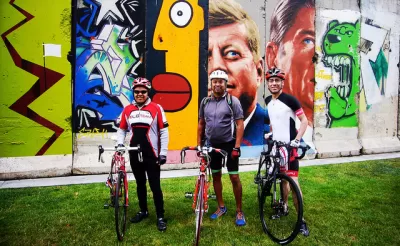
International Winter Bike to Work Day goes down this Friday, February 12. Picture high-fiving, Spandex, and pancakes and you’ll get the gist of the event. Happenings of this ilk will be dropping throughout the year to celebrate the bicycle-commuter-life as the healthier-mode-of-transportation-life. But the two-wheeler can be articulated to be more than just a vehicle. It can be a tool to spread social justice in our cities. The avenues of opening up justice are numerous; I'll focus here on the necessity to marginalize the automobile.
Philosopher and social critic Ivan Illich was fascinated by technology. Forty years ago he was arguing that the automobile, rather than a tool of freedom, contributed to entrenching mobility hierarchies. The car is at the sharp tip of the pyramid; all other transportation modes can get sucked under its tires. Where we've continued to allow the design of our cities to worship the automobile, Illich might have seen a monopoly, or worse, a dictatorship. He saw cities as subservient to this machine rather than an expression of people.
Illich couldn't have forecasted that motor vehicle crashes are one of the leading cause of death for those aged one to 34. Nor could he have fathomed that the use of a technology while driving could become such an epidemic. Distracted driving is the number one leading cause of car accidents in America. Drivers who use a hand-held device are four times more likely to get into a car accident than those who don't, and individuals who text are 23 times more likely to get into an accident.
These tragic and shocking statistics are normally framed as a safety issue. Make cars safer—improve seat belts, develop airbags, improve crash protection materials, set speed limits on streets. But allowing this technology to impose such colossal damage, Illich might have concluded, presses against our social justice.
Illich argued that the places where we live and work have changed precisely because of the automobile and its ever greater technological efficiency. In the four decades since this claim, the crash statistics suggest that the automobile's primacy has only become further entrenched, both culturally in our relationship to place and physically in the design of cities. In fact, society is so optimized to the combustion engine that we're now blind to its pervasive effects.
Reading Illich reminds us that people are essentially born with equal potential for mobility, which he connects to personal liberty. "Citizens of a society founded on the notion of equity will demand the protection of this right against any abridgment. It should be irrelevant to them by what means the exercise of personal mobility is denied, whether by imprisonment, bondage to an estate, revocation of a passport, or enclosure within an environment that encroaches on a person’s native ability to move in order to make him a consumer of transport. This inalienable right of free movement does not lapse just because most of our contemporaries have strapped themselves into ideological seat belts."
Illich believed that the bicycle could connect users back to the pace of community-oriented life. The technology of the bicycle wasn't beholden to modern society's penchant for speed. Automobile commuting to him would have been akin to the Ford factory production line, efficient yet hellish. Riding a bike can connect us back to place, which speed has torn us away from.
Implicitly, with his fascination for technology, Illich saw the bicycle as a tool of social justice. By gearing down the speed of every-day-life to bicycle speed, and having a transportation system that favoured this pace of life, the form of the city, in a sense, would be redistributed. Rather than the city oriented around the combustion engine (or electric for that matter) and its proclivity for speed, a bicycle-based transportation network would tax the automobile's efficiency, pocket-picking its wealth and sliding that over to people sitting on a saddle. To Illich, that'd be an act of social justice.
By seeking justice in terms of rearranging a type of physical environment to suit the bicyclist, the motor vehicle would become de-privileged. Bike lanes tucked into automobile traffic, Illich might have argued this incidental infrastructure would be akin to applying a Band-Aid on a gaping flesh wound. But acknowledging a wound is a first step towards imagining a better city form.
If we're interested in social justice, beginning to reorient the majority of the transportation infrastructure running through cities should be sought. Only by lessening our cultural and physical infrastructure worship with the automobile can we begin to form a type of city that, quiet simply, would bring us joy, as Illich might have said. (And even more joy when that international winter bike to work day ride comes with a pit stop high-five, a coffee, and some bacon.)
Connect with Steven on Twitter @stevenpsnell or Facebook stevenpsnell. Download his novel, Clear Running Water, at Smashwords.

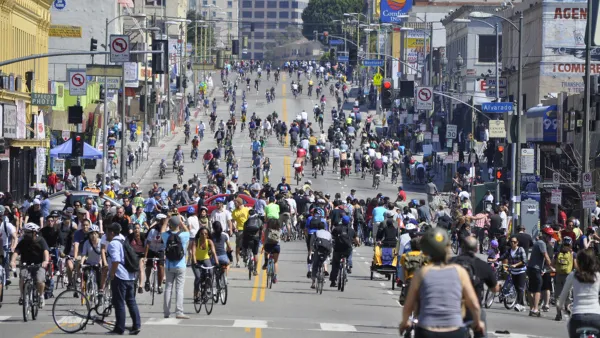
Mobility in Cities is About Space - Proven Powerfully in Pictures!
The biggest mobility challenge in cities isn't about what comes out of a car's tailpipe - it's about the massive amount of space that cars demand. Space to drive in, and space to park in. When explaining this, these pictures are worth 1000 words.
Philadelphia Leads the Largest Cities in America for Bicycle Mode Share
A new report from The Bicycle Coalition of Greater Philadelphia shows that Philadelphia's bicycle mode share is more than double that of Chicago's (the big city with the second-greatest share).
Milwaukee can now Impound Cars of Reckless Drivers
The city compares reckless drivers to firearms — “Let’s get as many of them off the street as possible.”

Planetizen Federal Action Tracker
A weekly monitor of how Trump’s orders and actions are impacting planners and planning in America.

Northwest rail fans eager for Sept. 30 debut of Amtrak’s Airo fleet
Get ready for that new train smell and more seats. But they won’t go faster or run more frequently on the Cascades route in Washington and Oregon.

Trump is considering data centers on 6 states' public land — some state officials say they had no idea
If the administration approves the proposed projects, data center and data center-related developments will cover 17,600 acres of public land.

Sharp cuts to federal passenger rail, public transit funding arrive today
The American Public Transportation Associations estimates the stopgap bill will result in an over 80% cut to federal passenger rail investment and 20% cut to public transit investment.

Chicago to showcase country’s first battery-operated passenger train
Metra estimates the trains will be ready for passenger use around the start of 2028.

After decades of planning, Sacramento gains new light rail station
Trains will arrive every 15 minutes during peak hours and every 30 minutes during non-peak hours.

FREE Course: Walkable City 1: Why Walkability?
After describing his path towards focusing on walkability as the essence of good planning, Jeff Speck marches through his five principal reasons for making more walkable places.
Reinventing Malls: Planning Alchemy—Turning Gray Fields Into Gold
The course focuses on the opportunities and imperatives that shape reinvention of mall sites.

City of Thousand Oaks
City of Wisconsin Rapids
Harvard University Graduate School of Design
The Architects Foundation
University of Cincinnati Online
Northern Illinois Transit Authority (NITA)
The Pocatello Development Authority
The Urban Renewal Agency of the City of Pocatello

