The Colorado Department of Transportation's RoadX pilot project will test early alerts to drivers on Interstate 70.


"As the federal government pushes toward a future where all new vehicles talk not only to each other but also to infrastructure, Colorado has decided to get a head start on finding out what that reality would look like using existing technology," reports Ben Miller.
"The Colorado Department of Transportation, working through its tech-focused RoadX program, intends to start piloting a program next year with the private company HERE to test connected vehicle concepts along one of its most challenging traffic corridors: Interstate 70....The pilot project will involve HERE setting up a smart phone application that will push out information to drivers about imminent hazards and road alerts — bad weather and accidents, for instance. The information will come over the existing LTE network, so it won’t require any sort of additional infrastructure investment on the part of the state."
The article includes more on the potential of vehicle-to-vehicle and vehicle-to-infrastructure technology and how useful existing infrastructure will be in realizing its future.
FULL STORY: Colorado Pushes for Early-Stage Vehicle-to-Vehicle, Vehicle-to-Infrastructure Test on Mountain Highways


Florida Could See Commercial Air Taxis by End of Year
The state wants to be the first in the nation to build infrastructure for commercial electric vertical take-off and landing aircraft (eVTOL).
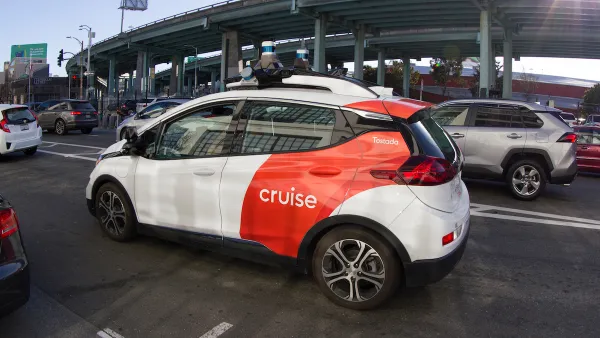
Cruise Suspends Driverless Operations, Waymo Pushes Ahead
While Cruise is pausing all of its autonomous services in a bid to “regain public trust,” Waymo, via Uber, will begin offering autonomous rides in Phoenix.

FCC Wants to Shift WiFi Bandwidth Away From the Transportation Sector
The scalability of vehicle-to-vehicle Internet technology hangs in the balance of a proposed rulemaking under consideration at the Federal Communication Commission.

Planetizen Federal Action Tracker
A weekly monitor of how Trump’s orders and actions are impacting planners and planning in America.

The state-sanctioned urbicide of Austin
People don’t kill cities. Freeways do.

US to reduce Colorado River water deliveries to Mexico
A new Colorado Treaty amendment reduces Mexico’s Colorado River water allocation by 250,000 acre feet.

5 New England states march closer to 800 megawatt wind energy project
Securing federal approval for the project may be complicated under the Trump administration, which has historically been hostile towards domestic wind power.

Baltimore to break ground on $50 million Transit Priority Project
The project will bring faster bus trips, safer streets and better bike connections to Baltimore.

Airbnb launches $250 million 'last-dollar financing' housing accelerator, makes first investment in Austin
The company will put $6.4 million towards affordable housing development in Texas’ capital.

FREE Course: Walkable City 1: Why Walkability?
After describing his path towards focusing on walkability as the essence of good planning, Jeff Speck marches through his five principal reasons for making more walkable places.
Reinventing Malls: Planning Alchemy—Turning Gray Fields Into Gold
The course focuses on the opportunities and imperatives that shape reinvention of mall sites.

Eagle County Government
Harvard University Graduate School of Design
Nashville Planning Department
The Architects Foundation
University of Cincinnati Online
The Pocatello Development Authority
The Urban Renewal Agency of the City of Pocatello
Journal of the American Planning Association