Mayor Rahm Emanuel announced an update of the city's 2013 transit oriented development ordinance. The new version of the ordinance would have a sweeping effect on the land uses around transit stations in Chicago.


"The office of Mayor Rahm Emanuel, who proposed and worked with City Council to pass a major TOD ordinance in 2013, unveiled a proposal for a reformed TOD ordinance," according to a post by Yonah Freemark for the Metropolitan Planning Council. For the record, the Metropolitan Planning Council "hails this proposed zoning ordinance as an important step forward in growing our city toward its transit system."
"An initial analysis of the ordinance conducted by MPC shows that the change would more than double the area of land benefiting from increased allowed density, compared with the 2013 ordinance, from 13 million sq. ft. of parcels to 31 million sq. ft. (this represents just a small portion of the city’s total developable area)," adds Freemark. The ordinance would also "increase by more than 10 times the area that would benefit from reduced parking requirements, from 86 million sq. ft. or parcels to 957 million."
The post includes a lot more info on the impacts the proposed ordinance could have enacted. For more information about the city's support of the new ordinance, which could be considered in September, see also a press release from the office of Mayor Rahm Emanuel about the proposed ordinance.
FULL STORY: City of Chicago unveils proposal for 2015 TOD ordinance

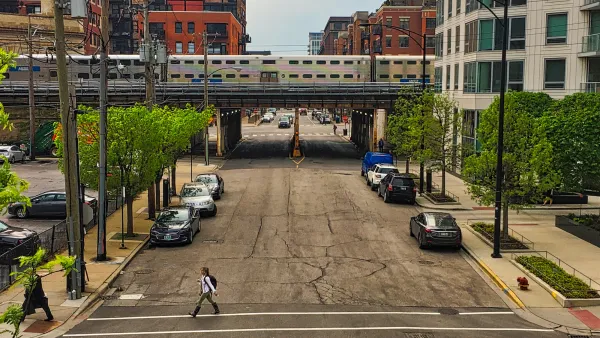
Chicago eliminates parking requirements near transit
In 2025, Illinois barred cities from mandating parking near train and bus stations.
Asheville Could Eliminate Parking Minimums
The city is working on a multiyear overhaul of its Unified Development Ordinance.
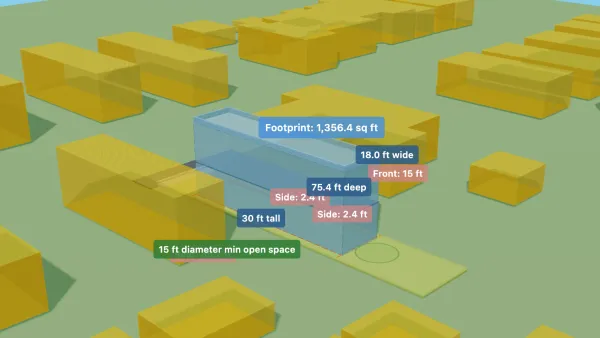
Interactive, 3D Chicago Zoning Map Lets You Visualize Potential Development
A new tool creates a visual model of potential development on Chicago lots based on the property’s specific zoning regulations.

Planetizen Federal Action Tracker
A weekly monitor of how Trump’s orders and actions are impacting planners and planning in America.

The state-sanctioned urbicide of Austin
People don’t kill cities. Freeways do.

US to reduce Colorado River water deliveries to Mexico
A new Colorado Treaty amendment reduces Mexico’s Colorado River water allocation by 250,000 acre feet.

5 New England states march closer to 800 megawatt wind energy project
Securing federal approval for the project may be complicated under the Trump administration, which has historically been hostile towards domestic wind power.

Baltimore to break ground on $50 million Transit Priority Project
The project will bring faster bus trips, safer streets and better bike connections to Baltimore.

Airbnb launches $250 million 'last-dollar financing' housing accelerator, makes first investment in Austin
The company will put $6.4 million towards affordable housing development in Texas’ capital.

FREE Course: Walkable City 1: Why Walkability?
After describing his path towards focusing on walkability as the essence of good planning, Jeff Speck marches through his five principal reasons for making more walkable places.
Reinventing Malls: Planning Alchemy—Turning Gray Fields Into Gold
The course focuses on the opportunities and imperatives that shape reinvention of mall sites.

Eagle County Government
Harvard University Graduate School of Design
Nashville Planning Department
The Architects Foundation
University of Cincinnati Online
The Pocatello Development Authority
The Urban Renewal Agency of the City of Pocatello
Journal of the American Planning Association