The former steel town of Lackawanna, in Erie County, New York, is the latest beneficiary of the growing reach of land banks.


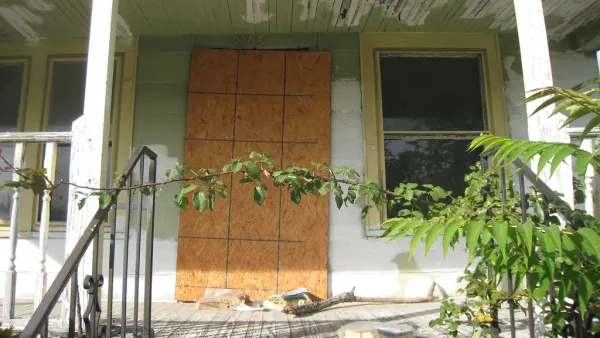
Harold McNeil reports on the first successful renovation of a formerly abandoned house by the Buffalo Erie-Niagara Land Improvement Corp. (a land bank, by any other name), in Lackawanna’s Second Ward.
"It is a first-of-its-kind revitalization effort that seeks to spare uninhabited and unattended properties from wrecker’s ball so they can be placed back on the real estate market – for more than double the investment," writes McNeil.
The success of the land bank's initial effort was first put in motion by a 2012 decision by New York Governor Andrew Cuomo to make it easier for counties, such as Erie County in this case, to create land banks for the purposes of reclaiming and rehabbing private properties.
According to Mcneil's reportage, "there are plans to renovate eight more reclaimed properties across the county this year, with the expectation that those efforts will be doubled in 2016."
Hat tip to the Lincoln Institute of Land Policy for sharing the article.
Read the full story: The Buffalo News
Cook County Land Bank Expands Vacancy Program, Offers 4,400 Lots for Sale
The vacant lot program at the Cook County Land Bank Authority recently kicked into high gear—offering a huge number of vacant lots for sale, located around 27 neighborhoods and suburbs in the Chicago region.
St. Louis Puts Renewed Effort Into Vacant Properties
St. Louis Public Radio explains the various efforts of the St. Louis Land Reutilization Authority.
Evansville, Indiana Looking to Land Bank to Solve Blight Problem
The city of Evansville will consider in the coming weeks a proposal to empower its land bank to take title and demolish roughly 200 properties. A recent report paid for by the city only bolsters the argument in favor of the action.

Planetizen Federal Action Tracker
A weekly monitor of how Trump’s orders and actions are impacting planners and planning in America.

Washington state to charge fee to drivers with fuel-efficient cars
Revenue from the fee will go towards supporting the state’s highways.

Illinois considers spending $1 billion in taxpayer money on data center
A quantum computing campus and data center are currently under construction in Chicago.

‘Demolition of our heritage:’ Some US tribes speak out against BAAJA
A coalition of indigenous groups in the United States are concerned about provisions in the bill that may weaken their ability to halt large energy projects.

How LA’s new mayor plans to tackle affordable housing crisis
Mayor-elect Nithya Raman has proposed overhauling the city’s permitting process.

Interactive map reveals Pennsylvania's abandoned oil, gas wells — many on residential property
It is difficult for residents to know if a well is near their home, or if it poses a threat to them.

FREE Course: Walkable City 1: Why Walkability?
After describing his path towards focusing on walkability as the essence of good planning, Jeff Speck marches through his five principal reasons for making more walkable places.
Reinventing Malls: Planning Alchemy—Turning Gray Fields Into Gold
The course focuses on the opportunities and imperatives that shape reinvention of mall sites.

City of Charlotte
City of Rosemead
Rutgers University, Edward J. Bloustein School of Planning and Public Policy
University of Michigan School for Environment and Sustainability (SEAS)
Hunter College, City University of New York (CUNY)
The Architects Foundation
University District Partnership