After narrowly escaping attempts to kill the project, the Cincinnati Streetcar is now faced with questions about how to fund and expand the system.


According to Sharon Coolridge, "Cincinnati City Council on Wednesday asked the city's administration to study expanding the streetcar to Uptown."
"The study will look at where future funding could come from and is not expected to cost taxpayers additional money, beyond city staff time," adds Coolridge.
The study moved forward on a 5-4 vote and despite a "lengthy argument" and notable opposition from Cincinnati Mayor John Cranley. Mayor Cranley called the decision to study the second phase irresponsible. Coolridge quotes the mayor directly asking a rhetorical question to explain his opposition: "Shouldn't the focus be on making the first phase a success?"
For those keeping track at home, Coolridge explains how the Uptown extension, as proposed for Phase II of the streetcar project, was a part of the original plan for the system until Ohio Governor John Kasich pulled all $52 million in state funding for the project in 2011. Local officials moved forward with Phase I, which runs through Downtown and Over-the-Rhine. Funding also figures into the projects recent controversies, and Mayor Cranley's concerns, because the city has yet to resolve a $600,000 deficit for operating Phase I of the system.
Coolridge also notes that the Uptown extension has already been studied: "In 2009, consultants completed a feasibility study on the Uptown route, and streetcar project leaders spent another $201,000 on two Uptown studies last year."
FULL STORY: Council OKs Uptown streetcar study

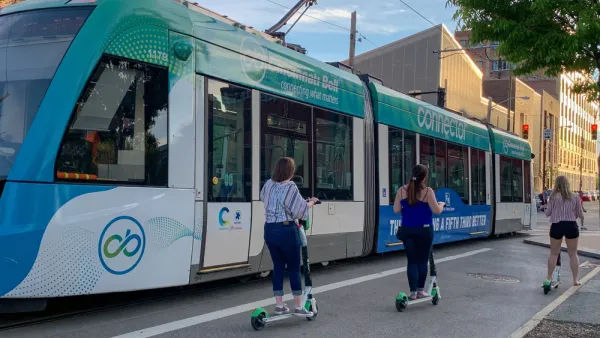
Cincinnati Streetcar Sets Monthly Ridership Record
The Cincinnati Streetcar, now known as the Cincinnati Connector, has come so far.
Cincinnati Streetcar Free Forever
The Cincinnati Bell Connector has been offering free rides since reopening in October, but the Cincinnati City Council recently decided to make the free rides a permanent feature.
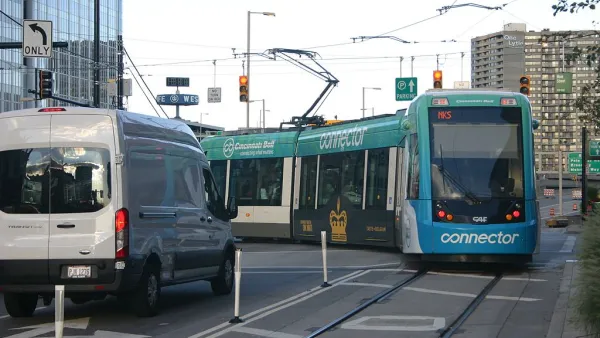
Streetcar Facing $1.4 Million Budget Deficit in Cincinnati
The Cincinnati Streetcar, now known as the Bell Connector, weathered numerous controversies on the way to completion. Now it faces the prospect of balancing its budget less than three years after launching.

Planetizen Federal Action Tracker
A weekly monitor of how Trump’s orders and actions are impacting planners and planning in America.

The state-sanctioned urbicide of Austin
People don’t kill cities. Freeways do.

US to reduce Colorado River water deliveries to Mexico
A new Colorado Treaty amendment reduces Mexico’s Colorado River water allocation by 250,000 acre feet.

5 New England states march closer to 800 megawatt wind energy project
Securing federal approval for the project may be complicated under the Trump administration, which has historically been hostile towards domestic wind power.

Baltimore to break ground on $50 million Transit Priority Project
The project will bring faster bus trips, safer streets and better bike connections to Baltimore.

Airbnb launches $250 million 'last-dollar financing' housing accelerator, makes first investment in Austin
The company will put $6.4 million towards affordable housing development in Texas’ capital.

FREE Course: Walkable City 1: Why Walkability?
After describing his path towards focusing on walkability as the essence of good planning, Jeff Speck marches through his five principal reasons for making more walkable places.
Reinventing Malls: Planning Alchemy—Turning Gray Fields Into Gold
The course focuses on the opportunities and imperatives that shape reinvention of mall sites.

Eagle County Government
Harvard University Graduate School of Design
Nashville Planning Department
The Architects Foundation
University of Cincinnati Online
The Pocatello Development Authority
The Urban Renewal Agency of the City of Pocatello
Journal of the American Planning Association