City officials in Seattle have proposed a levy on property owners that would finance an integrated approach to transportation infrastructure improvements.


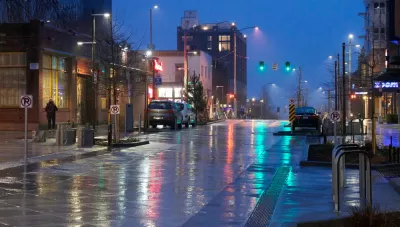
"Mayor Ed Murray and Seattle Department of Transportation Director Scott Kubly want to ask voters for approval of a 9-year, $900 million levy to fund the city’s new, integrated approach to transportation called 'Move Seattle,'" reports David Kroman.
According to Kroman, Move Seattle would replace the city's soon-to-expire "Bridging the Gap" levy, which raised $365 since it was launched in 2006. Kroman also describes Move Seattle as a "a much more aggressive approach to creating an integrated transportation system. In voicing his support for the initiative, Mayor Murray expressed his hope that it would end the "modal wars" between freight, bike, transit and cars.
Kroman describes how Move Seattle will work: "the plan will identify corridors within the city and define their main purpose. When possible, those corridors will be developed with all modes of transportation in mind — something akin to Downtown’s Second Avenue, which was recently redesigned to accommodate bikes, cars and freight. However, some corridors will be designated as 'freight corridors' or 'bike corridors' to reduce confusion and competition for right of way."
FULL STORY: World-class transportation? Ed Murray to ask voters for nearly a billion

Seattle Mayor Raises Transportation Levy by $100 Million
The proposal sent to City Council includes more funding for multimodal transportation and road safety.
Substantial Changes for Move Seattle Plan
The reality of the Move Seattle is proving to be much less robust than the vision promised to voters who approved the $930 million levy in 2015.
Seattle's New Updated Pedestrian Master Plan Includes $22 Million for Sidewalks
The promised update for the city of Seattle's Pedestrian Master Plan was released to the public last week.

The state-sanctioned urbicide of Austin
People don’t kill cities. Freeways do.

US to reduce Colorado River water deliveries to Mexico
A new Colorado Treaty amendment reduces Mexico’s Colorado River water allocation by 250,000 acre feet.

New Jersey’s second-largest city bans standalone data centers
Jersey City will continue to allow co-location facilities, such as those meant for research institutions that store their own data.

Amtrak not solely to blame for New Jersey commuter rail's unreliability, report finds
A new study from the Garden State Initiative found that NJ Transit’s budget grew 20% across a 4 year period, but reliability declined significantly over the same period.

EPA erases limits on planet-warming pollution from power plants
Under Monday’s plan, power plants would still have some limits on how much mercury, arsenic and other contaminants they can emit.

Phoenix announces new on-demand transit service, more frequent RAPID buses
Both new services will launch in October, and are part of Phoenix's Project Effective Access Solutions for Easing Congestion.

FREE Course: Walkable City 1: Why Walkability?
After describing his path towards focusing on walkability as the essence of good planning, Jeff Speck marches through his five principal reasons for making more walkable places.
Reinventing Malls: Planning Alchemy—Turning Gray Fields Into Gold
The course focuses on the opportunities and imperatives that shape reinvention of mall sites.

Eagle County Government
Harvard University Graduate School of Design
Nashville Planning Department
The Architects Foundation
University of Cincinnati Online
The Pocatello Development Authority
The Urban Renewal Agency of the City of Pocatello
Journal of the American Planning Association