Do bike helmet laws prevent injuries for children, or do they just discourage children from riding bikes?



Aaron Carroll shares news of research published by Health Economics, "Effects of Bicycle Helmet Laws on Children’s Injuries."
Carroll provides a summary of the findings of the study: "This study examined the association between bike helmet laws and head injuries. But they also looked at the effect of bike helmet laws on bike-related non-head injuries, and injuries from other wheeled activities not affected by helmet laws (ie skateboards). They found that, in kids age 5-19 years, helmet laws were associated with a 13% reduction in the incidence of bike-related head injuries. But they were also associated with a 9% reduction in bike-related non-head injuries."
In essence, bike helmets don't always prevent injuries for kids in the way one would expect: "This means that either wearing a helmet protected the body as well as the head, or that bike helmet laws worked by getting fewer kids to ride bikes. The researchers also saw an 11%increase in injuries from other wheeled activities. This would support the idea that some kids just started riding other devices, and still kept getting injured."
Carroll writes more on the possible consequences of helmet laws on bike safety for children.
Read the full story: Bicycle helmet laws reduce injuries for kids, but maybe not in the way you think

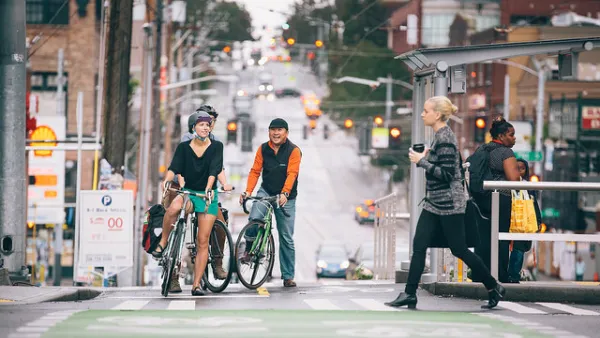
Bike Helmets No Longer Required in Seattle After Research Reveals Enforcement Disparities
The data on bike helmets have changed. Laws are starting to change too.

How Extreme Heat Impacts Children
As summers get hotter and more dangerous, parents can take steps to protect kids from heat-related illnesses.

Concrete to Community: A Schoolyard Makeover in West Philly
With guidance from the Trust for Public Land, third graders at Overbrook Elementary are leading the redesign of their asphalt schoolyard into a vibrant green space, learning valuable skills and creating lasting community impact in the process.

Planetizen Federal Action Tracker
A weekly monitor of how Trump’s orders and actions are impacting planners and planning in America.

Amtrak, CN end decades-long dispute with eight-year agreement
The new operating agreement establishes an updated framework for the companies to work together, including processes to resolve disputes.

Northwest rail fans eager for Sept. 30 debut of Amtrak’s Airo fleet
Get ready for that new train smell and more seats. But they won’t go faster or run more frequently on the Cascades route in Washington and Oregon.

Brightline Florida files for bankruptcy
The transit company is over $5 billion in debt.

St. Louis Metro to test if single-car trains can reduce operating costs, maintain rider satisfaction
The pilot program will run from October to spring 2027, and begin with one single-car train operating on Metrolink’s Red and Blue lines.

Pennsylvania is building data centers in abandoned mines
Housing data centers in mines provides an alternative to destroying local forests and may spare residents from data centers’ noise and air pollution.

FREE Course: Walkable City 1: Why Walkability?
After describing his path towards focusing on walkability as the essence of good planning, Jeff Speck marches through his five principal reasons for making more walkable places.
Reinventing Malls: Planning Alchemy—Turning Gray Fields Into Gold
The course focuses on the opportunities and imperatives that shape reinvention of mall sites.

City of Thousand Oaks
City of Wisconsin Rapids
Harvard University Graduate School of Design
The Architects Foundation
University of Cincinnati Online
The Pocatello Development Authority
The Urban Renewal Agency of the City of Pocatello