In the fifth of his "place-decoding" series from France, Chuck Wolfe recalls how we carry with us the ability to mine pride from place, even in places that are, perhaps, least expected to shine.


What do the politics of urban housing have to do with a seasonal caravan park in Provence, asks Wolfe?
Plenty, he notes, tying current debates about housing affordability in his native Seattle to exemplary illustrations from a manufactured housing community near Fréjus.
Recapping current focus both in Seattle and nationwide on issues such as micro-housing and linkage fees, he suggests that it is time to remember underlying, qualitative issues:
Our political discussions, mired in jargon and positioning, often lose sight of a human pride of place inherent in even the simplest forms of shelter.
He suggests, that when people take pride in where they live, their homes' appearance shows a bonding with the place, often with considered ingenuity. He provides examples from the Domaine du Pin de la Lègue, a 53 year-old caravan park (in American terms, a seasonal manufactured housing community), where, in addition to many "urban" services, there is the "pride of place surrounding the small living spaces in the homes all around, from clever retrofits to landscaping and rockeries befitting the best of single-family neighborhoods":
In the ways called for among some urban redevelopment movements today, small-scale innovation is on display---it's a locale where the plot-based, lean and pop-up urbanism movements of the United Kingdom and the United States merge with some admirable diversity.
Like a neighborhood, notes Wolfe, the homes become nurtured, planted around, and modified in functional ways, without expensive building materials, identities or complex regulatory tools.
Read the full story: Sustainable Housing, Politics and a Basic Pride of Place
Exploring the 'Finesse of the Avenue'
In his fourth "place-decoding" essay from France, Chuck Wolfe illustrates how a traditional placemaking intervention is especially powerful when underlying urban fundamentals align.
The Importance of Inter-Urban Walkability
In his third "place-decoding" essay from France, Chuck Wolfe recalls all that we can learn from walking between settled places.
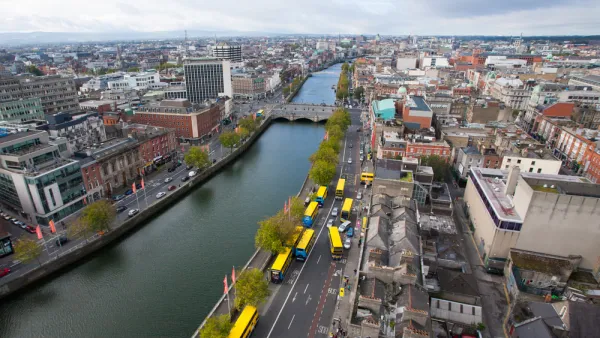
Reading Cities Cover to Cover, and Why
Chuck Wolfe underscores the importance of a holistic view of urban places, referencing themes of common experience, aesthetics, feelings of happiness, safety, or security—a basic narrative of the city that often goes beyond first impressions.

Planetizen Federal Action Tracker
A weekly monitor of how Trump’s orders and actions are impacting planners and planning in America.

Washington state to charge fee to drivers with fuel-efficient cars
Revenue from the fee will go towards supporting the state’s highways.

Study reveals best places in the U.S. for cycling, walking
New research from Streetlight Data examines bicycle and pedestrian miles per capita in the 100 largest U.S. cities by population.

Mamdani unveils his ‘most ambitious bus lane project’ so far
The city has added two new bus lanes, which it expects to speed up tens of thousands of bus riders’ commutes.

New Jersey and New York suggest $10.3 billion budget for transit
Some of the budget is dedicated to replacing Manhattan's Midtown Bus Terminal.

States split over EPA’s proposal to drop greenhouse gas rules for power plants
The proposed rule drew over 165K comments, including from officials, health and environmental groups, and private citizens.

FREE Course: Walkable City 1: Why Walkability?
After describing his path towards focusing on walkability as the essence of good planning, Jeff Speck marches through his five principal reasons for making more walkable places.
Reinventing Malls: Planning Alchemy—Turning Gray Fields Into Gold
The course focuses on the opportunities and imperatives that shape reinvention of mall sites.

City of Charlotte
City of Rosemead
Rutgers University, Edward J. Bloustein School of Planning and Public Policy
University of Michigan School for Environment and Sustainability (SEAS)
Hunter College, City University of New York (CUNY)
The Architects Foundation
University District Partnership
City of Cambridge
The Pocatello Development Authority