Jared Green asks the billion dollar question for economic developers and planning agencies throughout the United States: is urban revitalization of neighborhoods possible without the subsequent gentrification and displacement of current residents?


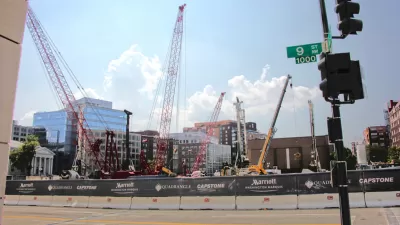
Jared Green asks this important question in a recent post on the American Society of Landscape Architect's blog, The Dirt. The most recent wave of "urban revitalization" that began in the 1990s to increase wealth in cities is noted by supporters as benefiting everyone, while critics are increasingly calling these initiatives gentrification. Given these disputes, Green discusses how cities can encourage growth while still providing a sense of neighborhood continuity, and how city planning departments can accommodate forces of change while respecting local communities and culture.
Green critiques Washington D.C., citing the work of Charles Hostovsky, an urban planning professor at Catholic University. Hostovsky's work centers on the speed of revitalization in the D.C. area, “[e]very neighborhood has cranes, signifying new development. There has been a corresponding shift in the demographics of the city. In 1970, the city was 77 percent African American. Today, it’s just 49 percent... Indeed: in the past decade, approximately 50,000 young, white Millennials have moved into the city while 35,000 African Americans have left.”
These changing demographics are stark. At a recent EcoDistricts Summit in Washington D.C., Hazel Edwards, professor of planning at Catholic University, discussed successful examples of urban revitalization from around the country that maintained local culture and minimized displacement. “Edwards said the key to revitalization without gentrification is 'bringing residents and the community to the table often and at the beginning.' This kind of public planning process requires a great investment of time and resources by city governments, but without this investment, the only result may be inequitable, developer-led urban revitalization.” In Hazel's words, “cities have to form diverse, inclusive partnerships, foster openness, and collaborate on goals and outcomes.”
Read the full story: Is Urban Revitalization Without Gentrification Possible?

Commentary: A New ‘Grand Bargain’ for American Housing
For decades, many U,S, neighborhoods successfully resisted change at the expense of a few neighborhoods sacrificed to mass development. Is there a better way?
Black Residents Leaving Cincinnati's Fast Growing Urban Area
The housing market in the neighborhood of Over-the-Rhine is a 'segregation machine.'
Revitalization Without Displacement: A New Model From Miami
Upzonings in working class neighborhoods usually provoke political opposition based on concerns about gentrification and displacement. But the new Wynwood Norte Neighborhood Revitalization District in Miami might have worked for a solution.

Planetizen Federal Action Tracker
A weekly monitor of how Trump’s orders and actions are impacting planners and planning in America.

Amtrak, CN end decades-long dispute with eight-year agreement
The new operating agreement establishes an updated framework for the companies to work together, including processes to resolve disputes.

Judges permit Denver to divert 77,000 acre feet from the Colorado River for reservoir expansion
Overuse and climate change have caused the Colorado River’s water levels to plummet.

Atlanta City Council unanimously backs $3.5 billion Beltline light rail project
The resolution was drafted after Atlanta Mayor Andre Dickens pulled support for the Atlanta Streetcar extension last year.

SEPTA to bring nearby frequent transit to over 1 million new riders as part of decade-long plan
The agency's Accelerate plan will also bring frequent transit to twice the amount of jobs that are currently located near it.

NYC plants over 18,000 trees, the most new foliage in a decade
Many of the trees were planted in communities vulnerable to extreme heat.

FREE Course: Walkable City 1: Why Walkability?
After describing his path towards focusing on walkability as the essence of good planning, Jeff Speck marches through his five principal reasons for making more walkable places.
Reinventing Malls: Planning Alchemy—Turning Gray Fields Into Gold
The course focuses on the opportunities and imperatives that shape reinvention of mall sites.

City of Thousand Oaks
City of Wisconsin Rapids
Harvard University Graduate School of Design
The Architects Foundation
University of Cincinnati Online
The Pocatello Development Authority
The Urban Renewal Agency of the City of Pocatello