The Bureau of Land Management will resume oil and gas leasing in California after a report by a scientific research organization established by the state legislature showed no correlation between fracking and groundwater pollution.


"The study was conducted by the California Council on Science and Technology, a nonpartisan scientific research organization established by the state Legislature [in 1988] to advise state officials," writes Julie Cart, environmental reporter for the Los Angeles Times. Based on the report's findings released Thursday (August 28) "that found little scientific evidence that fracking and similar extraction techniques are dangerous, the federal government will resume oil and gas leasing in California."
The Bureau of Land Management (BLM) commissioned the study, "Well Stimulation in California," after it lost a lawsuit in April, 2013 brought by fracking opponents Center for Biological Diversity and the Sierra Club who argued that additional environmental review was needed before BLM could auction rights for drilling in the Monterey Shale formation.
However, Cart writes that the "authors noted that they had little time and scant information on which to base conclusions, citing widespread 'data gaps' and inadequate scientific resources for a more thorough study."
That was the main point that David R. Baker, energy and clean tech reporter for the San Francisco Chronicle, emphasized in his piece. "There are no recorded cases of that happening in California, the authors note, but it remains a possibility needing further study," he writes.
The report will provide guidance for safe drilling operations, said Jim Kenna, the bureau's California state director. The report delves into issues ranging from the amount of water used by fracking in California - an amount significantly smaller than in other states - to the possibility that disposing of fracking waste water deep underground could trigger earthquakes.
Read the full story: Fracking report clears way for California oil, gas leasing to resume

Environmentalists Win Major Fracking Lawsuit in California
Environmentalists scored a major victory in federal court in their battle against fracking in California when a judge ruled that the BLM violated NEPA by not requiring an environmental review prior to auctioning rights for drilling in Monterey Co.
The Paradox of Reduced Oil Reserve Estimates
Until recently, California's Monterey Shale was estimated to have the nation's highest amount of recoverable oil. Then the Energy Department revised their estimates, lowering it 96%, which turned out to be bad news for fracking moratorium advocates.
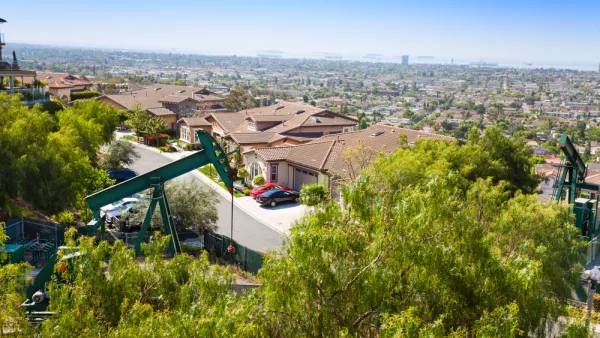
Trump Administration Reopens California Public Lands to Oil and Gas Drilling
A decision by the Bureau of Land Management on Oct. 3 may reverse the outcome of a 2013 lawsuit against the Obama administration by two environmental groups that effectively halted drilling in Fresno, Monterey and San Benito counties.

Planetizen Federal Action Tracker
A weekly monitor of how Trump’s orders and actions are impacting planners and planning in America.

Amtrak, CN end decades-long dispute with eight-year agreement
The new operating agreement establishes an updated framework for the companies to work together, including processes to resolve disputes.

Judges permit Denver to divert 77,000 acre feet from the Colorado River for reservoir expansion
Overuse and climate change have caused the Colorado River’s water levels to plummet.

NYC DOT wants faster, more permanent street upgrades
The city is examining ways to build more concrete infrastructure without getting entangled in 'decades-long' projects.

'Something we’ve never seen before:' rising utility rates could strain city finances nationwide
Data centers, climate change and other factors have caused utility rates in the United States to increase by 38% since 2020.

Trump to overrule local leaders, lease millions of acres of America’s Pacific Island territories’ seafloors to mining companies
International law says that the Indigenous people of America’s territories have a right to prior and informed consent regarding projects that impact their countries.

FREE Course: Walkable City 1: Why Walkability?
After describing his path towards focusing on walkability as the essence of good planning, Jeff Speck marches through his five principal reasons for making more walkable places.
Reinventing Malls: Planning Alchemy—Turning Gray Fields Into Gold
The course focuses on the opportunities and imperatives that shape reinvention of mall sites.

Harvard University Graduate School of Design
KFH Group Inc.
Greater Baltimore Committee
The Architects Foundation
University of Cincinnati Online
The Pocatello Development Authority
The Urban Renewal Agency of the City of Pocatello