Environmentalists scored a major victory in federal court in their battle against fracking in California when a judge ruled that the BLM violated NEPA by not requiring an environmental review prior to auctioning rights for drilling in Monterey Co.


Virginia Hennessey writes about the decision by U.S. Magistrate Judge Paul Grewal in San Jose, made public April 7.
Grewal faulted the Bureau of Land Management for not reviewing the potential impacts caused by fracking before accepting bids for the drilling rights, in accordance with the National Environmental Policy Act.
The law suit against BLM had been brought by the Center for Biological Diversity (see press release) and the Sierra Club.
"This is a watershed moment — the first court opinion to find a federal lease sale invalid for failing to address the monumental dangers of fracking", proclaimed Brendan Cummings, senior counsel at the Center for Biological Diversity
Hennessey writes that the ruling will have far-reaching effects on fracking in what is believed to be the shale basin holding the most oil in the U.S.
While the ruling directly affects lease sales on only about 2,500 acres in south Monterey County, the lawsuit's co-plaintiffs are poised to sue over 17,000 acres that BLM subsequently auctioned off in December 2012 while Grewal's ruling was pending.
In addition to the litigation, "Monterey County Supervisors Dave Potter and Simon Salinas were two of the local representatives who sought the delay of the 2012 lease sales.
"This puts the brakes on and forces everyone to do more environmental review," said Salinas, adding that it may provide time for passage of state legislation to ensure safety.
On those lines, Jeremy B. White of the Sacramento Bee writes that one such bill that "would require the energy industry to disclose more information about the amount of water and types of chemicals it uses" cleared the state senate on April 9.
Sen. Fran Pavley, D-Agoura Hills, the author of Senate Bill 4, called it a needed mechanism for holding the energy industry accountable.
Read the full story: Judge: U.S. violated law in Monterey County oil leases
Report: Fracking Doesn't Pose Danger to California Groundwater
The Bureau of Land Management will resume oil and gas leasing in California after a report by a scientific research organization established by the state legislature showed no correlation between fracking and groundwater pollution.
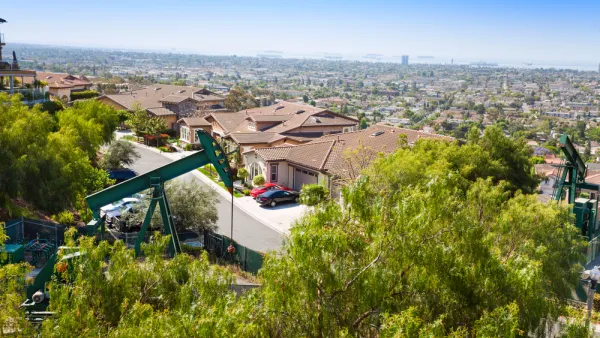
Trump Administration Reopens California Public Lands to Oil and Gas Drilling
A decision by the Bureau of Land Management on Oct. 3 may reverse the outcome of a 2013 lawsuit against the Obama administration by two environmental groups that effectively halted drilling in Fresno, Monterey and San Benito counties.

Department of Interior Plans to Open 1 Million Acres in California to Fracking
The Bakersfield Office of the Bureau of Land Management released an environmental study that is the basis for undoing a 2013 de facto moratorium on fracking on federal lands in California. The Supplemental EIS triggers a 45-day public comment period.

Planetizen Federal Action Tracker
A weekly monitor of how Trump’s orders and actions are impacting planners and planning in America.

California plans to bury El Niño’s downpour
If the state plays its cards right, it may be able to store a billion acre-feet of El Niño’s water in aquifers.

Desperate measures: Advocates weigh draining Lake Powell to fill Colorado River
Draining the reservoir could reduce evaporation losses by a couple hundred thousand acre-feet.

Chicago voters approve permanent festival grounds, penalty for vacant property owners
Currently, major summer and fall festivals take over public parks for weeks at a time, drawing criticism from nearby residents

NYC votes to cut outdoor dining red tape, speed up permitting
New York City also voted to allow the Department of Transportation to begin work on urgent projects before notifying elected officials.

California appears to reject Prop. 45
The proposition would have expanded the projects that qualify for a streamlined environmental review, effectively paring down the California Environmental Quality Act.

FREE Course: Walkable City 1: Why Walkability?
After describing his path towards focusing on walkability as the essence of good planning, Jeff Speck marches through his five principal reasons for making more walkable places.
Reinventing Malls: Planning Alchemy—Turning Gray Fields Into Gold
The course focuses on the opportunities and imperatives that shape reinvention of mall sites.

City of Rosemead
Rutgers University, Edward J. Bloustein School of Planning and Public Policy
One Hundred Miles
Hunter College, City University of New York (CUNY)
The Architects Foundation
University of Cincinnati Online
City of Cambridge
Montrose County
The Pocatello Development Authority