Los Angeles is coming of age, and with many cultures inhabiting many waves of development over the course of its settlement, the city's history is deep and rich. Recent articles detail multiple planning efforts aimed at preserving the city's history.


"Los Angeles…is constantly changing, constantly reinventing itself. But there’s an effort under way now to document its history, its neighborhoods, its buildings, its people, its cultural heritage, all that goes into making city what it is," reports Jeffrey Brown.
Brown's report details the development and application of the Arches database, developed by the Getty Conservation Institute to help catalogue the ancient treasures at risk due to the war in Iraq. "In fact, [Los Angeles] has become the largest test case for the new computer program in a project called Survey L.A."
"Iconic symbols are included, of course, the Hollywood sign, the Walk of Fame, the Capitol Records Building, historic movie theaters. But there are also many lesser-known places."
Ken Bernstein, who heads the city’s Historic Resources Department explains why the effort is so important: "Los Angeles always has significant development pressures, and there is heritage at risk as a result. And so we want to be able to use this survey information to make better planning decisions."
In related news, Bernstein's department also recently requested funds to support the creation of new Historic Preservation Overlay Zones (HPOZs) in the city. The Los Angeles Times recently published an editorial in support of the budget request. Their case includes an overview of the preservation mechanisms currently in place in the city: "There are currently 30 Historic Preservation Overlay Zones in the city covering a variety of neighborhoods and 25,000 properties. Another 15 neighborhoods are in the process of applying for this designation, but their applications are stalled. The city Planning Department, lacking the staff necessary to oversee the HPOZ process, has effectively put them on hold." The funding is especially needed now that the city's real estate market is heating up again, according to the editorial.
Read the full story: Preserving the cultural treasures of Los Angeles, one block at a time

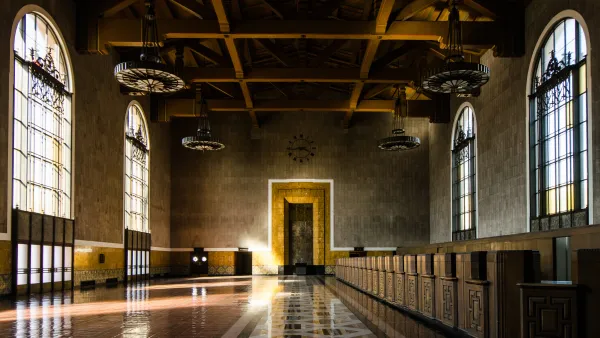
Los Angeles and the Getty Launch Historic Places Database
Confirmed: Los Angeles really does have a rich history. HistoricPlacesLA, a new online database, provides detailed information on the city's historic sites.
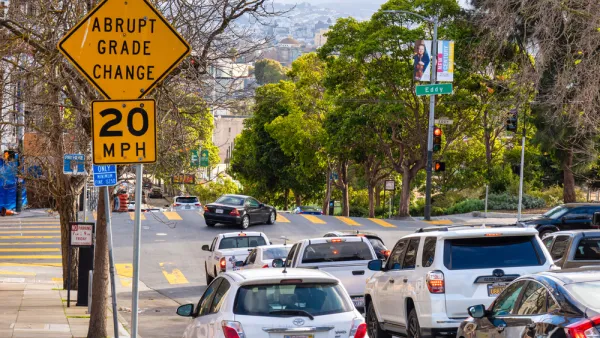
The Causes of California's Development Malaise
A spate of recent articles has taken a critical look at the regulatory obstacles to a progrssive planning vision in the state of California.
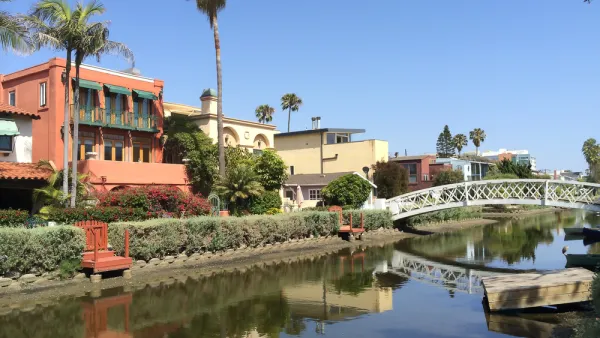
L.A. Made Your House Historic and Never Told You
According to this op-ed, the city of Los Angeles is implementing a sweeping, yet almost completely unpublicized, effort to give historic status to tens-of-thousands of homes and properties across the city, without ever telling anyone about it.

Planetizen Federal Action Tracker
A weekly monitor of how Trump’s orders and actions are impacting planners and planning in America.

Data reveals that NYC’s bet on congestion pricing has paid off
After almost two years of the program, reports show positive impacts on traffic and air quality and no disruptions to parking.

Denver is solving homelessness. Why aren't the rest of us?
Since 2023, Denver's street homeless population has decreased by 64%, proving that effective tools exist to support those in need of housing.

Michigan needs billions to save its water infrastructure. The state won't fund it
Michigan needs to invest $2.8 billion per year over the next 20 years to fix its water infrastructure. The FY 2027 budget allocates only $27.9 million.

Trump asks Supreme Court to allow border wall through Texas national park
Judge Kathleen Cardone previously blocked the Big Bend border wall project, and Texas’ Land Commissioner has spoken out against it as well.

This MA town is drowning in its own sewage — and residents like it that way
Susan Murcott, a waste water expert, said if Carlisle didn't address their leaking sewage, the problem could turn “deadly.”

FREE Course: Walkable City 1: Why Walkability?
After describing his path towards focusing on walkability as the essence of good planning, Jeff Speck marches through his five principal reasons for making more walkable places.
Reinventing Malls: Planning Alchemy—Turning Gray Fields Into Gold
The course focuses on the opportunities and imperatives that shape reinvention of mall sites.

City of Rosemead
Rutgers University, Edward J. Bloustein School of Planning and Public Policy
One Hundred Miles
The Architects Foundation
University of Cincinnati Online
Montrose County
Northern Illinois Transit Authority (NITA)
The Pocatello Development Authority