Jim Oberstar was elected 18 times to Congress, serving Minnesota's 8th Congressional District from 1975 to 2011. He died suddenly in his sleep on Saturday, May 3, 2014.


Jim Oberstar, the longtime representative of Minnesota's 8th Congressional District, died suddenly in his sleep on Saturday, May 3, 2014.
Julie Kosbab provides an obituary, with personal touches and attention to Oberstar's accomplishments as a Minnesota Congressman and as chair of the House Transportation Committee. "This was not a man talking the talk," writes Kosbab. "Oberstar was a passionate advocate of a carbohydrate-based transportation system. He’d taken up bicycling as a response to grief after the death of his first wife, and converted members of his staff to bike commuters. He co-authored, sponsored and helped pass the milestone SAFETEA-LU legislation in 2005. SAFETEA-LU provided not only for bridges and roads, but for public transportation support and alternative transportation. It was the launchpad for Safe Routes to Schools, a program intended to support and encourage kids to again walk and ride to school. It was also the source of $25 million in federally funded improvements for the city of Minneapolis to encourage bicycling as a significant mode share, under a program known as the Nonmotorized Transportation Pilot Program."
In a separate article, Baird Helgeson and Kelly Smith detail the accomplishments of Oberstar's life, including his actions after the Interstate 35W bridge collapse in Minneapolis in 2007, when he "ensured rapid passage of $250 million in federal money to build a replacement."
Read the full story: In Memoriam: Jim Oberstar (1934-2014)
What Are (Realistic) Options For Federal Transportation Funding?
With the unlikely possibility of the Congressional conference committee agreeing to a new transportation bill, much less an agreement to address the decreasing gas tax revenues to the Highway Trust Fund, Kathryn Wolfe looks at the remaining options.
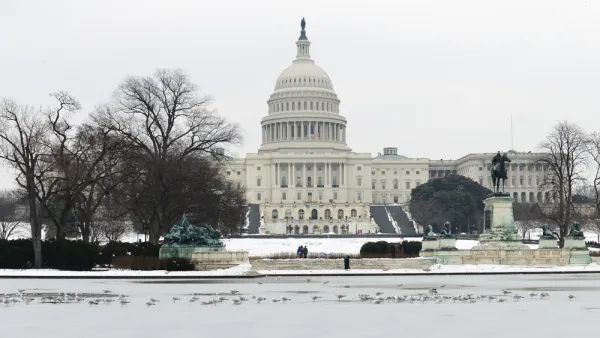
Transportation Priorities of the New Democratic Leadership in the House
With Democrats rising to power in the U.S. House of Representatives and the government recently reopened (temporarily at least), it's time to plot the legislative ambitions of the coming session in Congress.
Two-Week Transportation Extension 'Auto-Signed' by President Obama
With transportation taxing and spending authority set to expire on Friday night, President Obama used an auto-pen to sign the extension on a plane to Malaysia. Both chambers must agree to the bill that emerges from the conference committee by Dec. 4.

Planetizen Federal Action Tracker
A weekly monitor of how Trump’s orders and actions are impacting planners and planning in America.

Eastern Nebraska is running out of electricity
Data centers and electrification are straining eastern Nebraska’s grid, throttling economic development.

Study reveals best places in the U.S. for cycling, walking
New research from Streetlight Data examines bicycle and pedestrian miles per capita in the 100 largest U.S. cities by population.

DSA members accuse Mamdani of 'abandoning values' over housing redevelopment
New York City's mayor plans to replace about 2,000 units of public housing with private, mixed-income housing.

All sides of BRT debate unhappy with CDOT’s most recent move
The Colorado Department of Transportation is no longer considering center-running bus lanes for Colorado Boulevard.

Massachusetts bogs generate both power, and cranberries
Putting solar panels above farmland is one way Massachusetts is advancing toward its goal of net-zero carbon emissions by 2050.

FREE Course: Walkable City 1: Why Walkability?
After describing his path towards focusing on walkability as the essence of good planning, Jeff Speck marches through his five principal reasons for making more walkable places.
Reinventing Malls: Planning Alchemy—Turning Gray Fields Into Gold
The course focuses on the opportunities and imperatives that shape reinvention of mall sites.

City of Rosemead
Rutgers University, Edward J. Bloustein School of Planning and Public Policy
One Hundred Miles
University of Michigan School for Environment and Sustainability (SEAS)
Hunter College, City University of New York (CUNY)
The Architects Foundation
City of Cambridge
The Pocatello Development Authority
The Urban Renewal Agency of the City of Pocatello