Why housing should take priority in the effort to attract families back to the city (and welcome them to stay awhile).


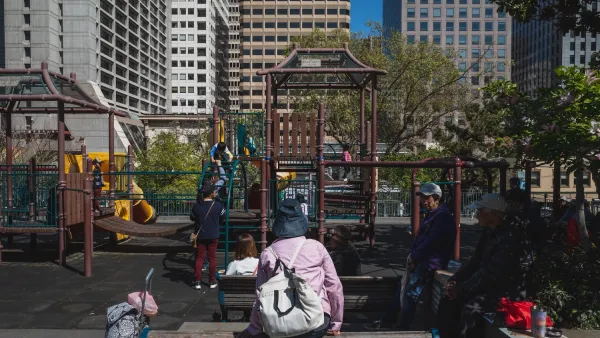
A couple of weeks ago, an article by Chris Bruntlett provided examples of whimsical and fun ways to make cities friendly to children. Bruntlett described multiple street installations and unstructured recreational space found only in urban cores. These are the opportunities that make our cities, particularly center cities, the unique and vibrant places so many people currently want to live. Sadly this type of unique urbanism cannot be fully realized if we do not make our cities, and our downtowns, suitable places for families to reside. In fact, so few children live in our cities that whimsy and unique approaches to leisure and play serve very few.
Cities, and more notably downtowns and other urban centers, are presumed to be unattractive locations for families. That may well be the case for many families, but there are still those that want to take advantage of the diversity, convenience, and complexity of urban cores. Unfortunately we fail to provide the option to do so—and option should be the key word. Not only do we limit the options for family-friendly urban living, we overwhelmingly discourage it while also subsidizing its alternatives. We limit options, for instance, by letting our urban school system deteriorate, depending instead on private and suburban schools to provide education resources. We fail to provide housing that is both appropriately scaled and appropriately priced. And we fail to dispel preconceived notions of crime and safety that date back to the 1970s and 1980s.
But of these and many other issues, housing may be the largest impediment to families that want to reside in our urban cores. If we cannot provide adequate housing options for families, particularly those of the middle class, then many of the whimsical additions like those describe by Bruntlett will be for naught.
Housing Shortfalls (And Possible Solutions)
Recent American Community Survey data (2006-2011, 5 Year estimates) shows that in Atlanta, only 19 percent of households with children in Midtown and Downtown fall between 75 and 125 percent of Median Family Income; 60 percent are above 125%. We have priced and sized families out of urban cores, which only serve those at the economic extremes. Developers are skeptical of building larger units, and cities have become obsessed with attracting “young professionals,” with no plan to retain them as they grow and age. There are many “age in place” campaigns, such as the Atlanta Regional Commission’s Lifelong Communities, which allow the elderly and retired to remain in their community through a variety of services and housing options, in lieu of entering a retirement facility. Yet we do not see the same care and consideration given for family households. Instead, we accept a predetermined fate that suburbs are the only suitable places for children.
No family with the desire to live in an urban core expects a single-family home with a yard—and if they do, the city is likely not for them. But there are many families that do accept a trade off in square footage for the benefits of living in the city. Such urban-oriented families and supporting activities are profiled on websites in Los Angeles, and Austin. These families are willing to accept a smaller home and little-to-no private green space in exchange for culture, amenities, increased autonomy, and access to some of the world’s greatest parks. That does not mean that they should have to cram families of three or four into one and two bedroom apartments and condos.
Moderately priced one-bedroom units can accommodate young professionals and married couples. Moderately priced two-bedroom units are suitable as well for married couples and even for those with one child. Three bedroom units are optimal for an urban family, yet are a rarity in both availability and affordability. Importantly, providing diverse housing solutions creates communities that allow everyone to age in place, not just the elderly.
The “Vancouver model” of a townhome podium with a setback high rise provides an ideal example of urban housing by addressing many of the concerns and desires related to privacy, size, and long-term residence. While Vancouver hasn’t mastered the affordability of these units, other cities can and should continue to improve the model. Most mid- and high-rise developments, particularly in Atlanta, are inactive at the street level. Be it blank walls, leasing offices, or empty retail space, these facades are perfect locations to create a more diverse housing stock.
The Benefits of Diverse Housing Options
Diverse housing stock, in fact, is the key to creating a vibrant and diverse community. Here are a few examples of the needs diverse housing stock fulfills:
- Provides convenient access, increased privacy, and opportunities for all demographics to age in place.
- Allows transitions between housing options within the same community and addresses the changing needs of households.
- Creates enhanced investment and attachment to a community, while increasing neighborhood stability and long-term potential.
- Helps cities retain their once-young professionals as they reach peak earning years and reduces the need to continuously attract and re-attract young professionals.
Community Investment
While Vancouver can afford to add whimsical play features to the urban fabric, the discussion in U.S. cities must begin with housing. San Francisco’s streetscape swings and musical stairs are commendable, but they will serve as nothing more than a weekend amenity if the city cannot provide adequate and attractive housing for families. The city should not be reserved for special outings—it should serve and welcome residents of all ages and income levels as a classroom, laboratory, and living room.
For other cities, urban public education is likely to only be reformed by those that live in the community. Education reform requires involvement by parents, future parents, and non-parents. Unless we can create communities that are suitable for residents of all ages and life stages, we will not be able to attract residents vested in their community for the long term.
Housing options that meet income and size needs provide incentives for community members to invest in their communities. Using density bonuses and overlay districts, cities should identify communities based on their access and proximity to services and facilities that families need, such as childcare, schools, transit, and parks. Cities should identify neighborhoods as priorities for development of urban family-friendly housing and require minimum percentages of two- and three-bedroom units in new developments. To support overlay and density bonuses, cities should also invest in whatever infrastructure requires upgrades.
Of course, there are many other initiatives that must take place concurrently with housing development. Cities must market themselves appropriately, capitalizing on their existing strengths and educating the public new, family-focused facilities and amenities. Luring families away suburban communities is unlikely, but convincing early adopters and natives to remain represents the greatest opportunity.
Cities must also get serious about education, rely less on money that isn’t there, and engage all citizens, not just parents, to get involved with improving their local schools. Community involvement is essential in convincing neighborhood stakeholders that the success of local schools precipitates the success of everyone in the neighborhood. Neighborhood stability and property value, whether one has children or not, should be a priority. Schools should be resources for the entire community, serving a multitude of recreational and education purposes for people of all ages.
If they can succeed in living together, cities and families stand to benefit in profound ways. If they can attract and retain families, cities will populate with residents in their peak earning years, stabilize neighborhoods, and attract households who spend a majority of their disposable income—an amount that exceeds the coveted young professional and elderly markets—within the local economy. For families, cities offer opportunities to live in a more diverse and active environment, reduce dependency on automobiles for chauffeuring children, and spend more quality time as a family. Cities provide a wealth services, amenities, and culture that can only be found in city centers and never replicated in a lifestyle center or new urbanism developments on the fringes of metropolitan areas.
Once we have built the housing that provides options and opportunities for families to live practically, we can then turn greater focus on whimsical and fun elements. If we don’t take these first steps first, neighborhood amenities will merely serve as photo ops for weekend visitors and tourists.
Bradley Calvert is an architect in Atlanta, Georgia and is completing his graduate degree in City and Regional Planning at the Georgia Institute of Technology this spring. He is a father of one, raising a family in the city.

Report Shows San Francisco’s ‘Family Zoning’ Plan Would Produce Less Than Half of Needed Housing Units
The city’s economic analysis reveals that a rezoning proposal would yield from 8,504 to 14,646 units, well below the number required by the state.

Opinion: What San Francisco’s Proposed ‘Family Zoning’ Could Really Mean
Mayor Lurie is using ‘family zoning’ to encourage denser development and upzoning — but could the concept actually foster community and more human-scale public spaces?

New Report Plans Toronto at Kid Scale
Toronto has released draft urban design guidelines that put families with children at the center of the city.

Planetizen Federal Action Tracker
A weekly monitor of how Trump’s orders and actions are impacting planners and planning in America.

Amtrak, CN end decades-long dispute with eight-year agreement
The new operating agreement establishes an updated framework for the companies to work together, including processes to resolve disputes.

Judges permit Denver to divert 77,000 acre feet from the Colorado River for reservoir expansion
Overuse and climate change have caused the Colorado River’s water levels to plummet.

New bill requires California data center developers to create water scarcity plans
Gov. Gavin Newsom recently signed 7 bills intended to give California communities more information about the impact of proposed data centers.

San Diego may kill one-third of its bus routes as budget crisis looms
Under the city's proposed plan, 21% of Metropolitan Transit System riders would lose access to transit services.

Philadelphia to invest $2 billion into upgrading city airports as PHL places last in customer satisfaction
Modernizations to Philadelphia's airports will include baggage system upgrades and a new automated parking garage guidance system.

FREE Course: Walkable City 1: Why Walkability?
After describing his path towards focusing on walkability as the essence of good planning, Jeff Speck marches through his five principal reasons for making more walkable places.
Reinventing Malls: Planning Alchemy—Turning Gray Fields Into Gold
The course focuses on the opportunities and imperatives that shape reinvention of mall sites.

City of Wisconsin Rapids
Harvard University Graduate School of Design
KFH Group Inc.
The Architects Foundation
University of Cincinnati Online
The Pocatello Development Authority
The Urban Renewal Agency of the City of Pocatello

