A repair crew was en route to investigate a complaint of gas odor when the two five-story, one-hundred-year-old buildings in East Harlem exploded, killing seven with eight still missing as of press time. Leaking cast iron pipelines may be to blame.


Aging, cast iron pipes carry much of New York City's natural gas to buildings. Earlier in the week, "a report from the Center for an Urban Future found many items such as water mains, subways, roads and public buildings, in need of serious repair," writes Alec Hamilton.
On WNYC, Jonathan Bowles, executive director of the center, appears as a guest.
"So when you first heard about the explosion..., did your mind immediately go to aging infrastructure?", asks the moderator.
"It really did," Bowles replies. However, he adds that "it's rare that aging infrastructure leads to disaster on this scale but some parts of the city's gas system aren't in good shape," writes Hamilton.
"There's a ton of cast iron gas mains all over the city, and they're not leading to these kind of disasters every day or every week" he said, "But there are a lot of leaks."
"The report found that more than half of the city's gas lines are made up of cast iron or unprotected steel—the most leak-prone material," writes Hamilton, adding that replacing it woud be an exorbitant cost: "$2 million to $8 million per mile and more than a thousand miles under ConEd's portfolio."
However, fines for preventable explosions caused by leaking gas pipelines can be exorbitant as well. Take the San Bruo, Calif. explosion in 2010 that killed eight, for example. Last year, PG&E agreed to pay $565 million to victims.
However, that's in addition to a $2.25-billion penalty proposed by the California Public Utilities Commission, "but the San Francisco-based utility claims the true cost to its shareholders would approach $4 billion," according to ENR California.
Bowles tells WNYC that it's "probably not realistic to expect" all those cast iron pipelines to be replaced, "but we do think there could be an acceleration of the replacement of these gas mains." Furthermore, he emphasizes the importance of alerting the utility immediately when the odor of natural gas is detected.
The Brian Lehrer Show has Thursday coverage on the explosion and a Tuesday interview (before the explosion) of onathan Bowles and the Center for Urban Futures report.
For an image of the original tenements that had a church and a piano store on the ground levels and a photo gallery and video of the scene of the explosion, see the New York Times article.
Read the full story: Report Raised Red Flags About Infrastructure Before Collapse

Is $1.4 Billion Enough Punishment for Deadly Natural Gas Explosion?
With a final decision expected later this year, the California Public Utilities Commission recommended a $1.4 billion fine for PG&E in connection with violations leading to a natural gas explosion in 2010.

Wine Country Wildfires Put Spotlight on Transmission Lines
No cause has yet been attributed to California's deadliest wildfires, but the connections to fallen power lines and exploding transformers, maintained by PG&E, have been exposed in a series of reports by the Bay Area News Group.
Will Electric Utilities Disrupt the Oil Industry in California?
A key bill had language allowing public utilities to enter into the electric vehicle charging industry—overlooked by the oil industry and a game-changer for EVs as it tackles one of their most formidable challenges.

Planetizen Federal Action Tracker
A weekly monitor of how Trump’s orders and actions are impacting planners and planning in America.

Amtrak, CN end decades-long dispute with eight-year agreement
The new operating agreement establishes an updated framework for the companies to work together, including processes to resolve disputes.
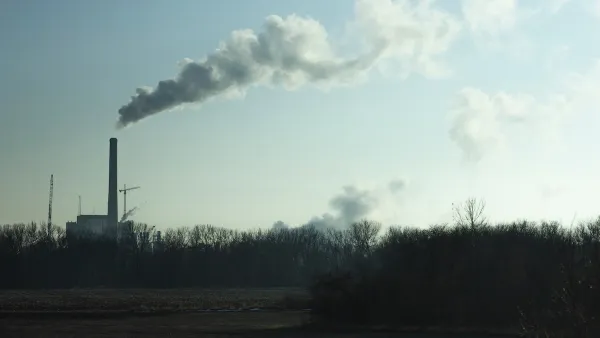
Nation's most wind-powered state turns to coal as data centers increase energy demand
For the first time in decades, Iowa has increased its generation of coal power.

Alabama scores up to $2.5 billion federal loan for largest infrastructure project in state’s history
The Mobile River Bridge and Bayway Project aims to ease congestion at Alabama’s worst bottleneck.

Trump is considering data centers on 6 states' public land — some state officials say they had no idea
If the administration approves the proposed projects, data center and data center-related developments will cover 17,600 acres of public land.

Despite court ruling, Trump is keeping nearly all wind projects in the US on hold
At least 110 wind energy projects have not heard from the government since a federal judge ruled that the Trump administration's freeze on wind turbine clearances was likely illegal.

FREE Course: Walkable City 1: Why Walkability?
After describing his path towards focusing on walkability as the essence of good planning, Jeff Speck marches through his five principal reasons for making more walkable places.
Reinventing Malls: Planning Alchemy—Turning Gray Fields Into Gold
The course focuses on the opportunities and imperatives that shape reinvention of mall sites.

KFH Group Inc.
Greater Baltimore Committee
Eagle County Government
The Architects Foundation
University of Cincinnati Online
The Pocatello Development Authority
The Urban Renewal Agency of the City of Pocatello